



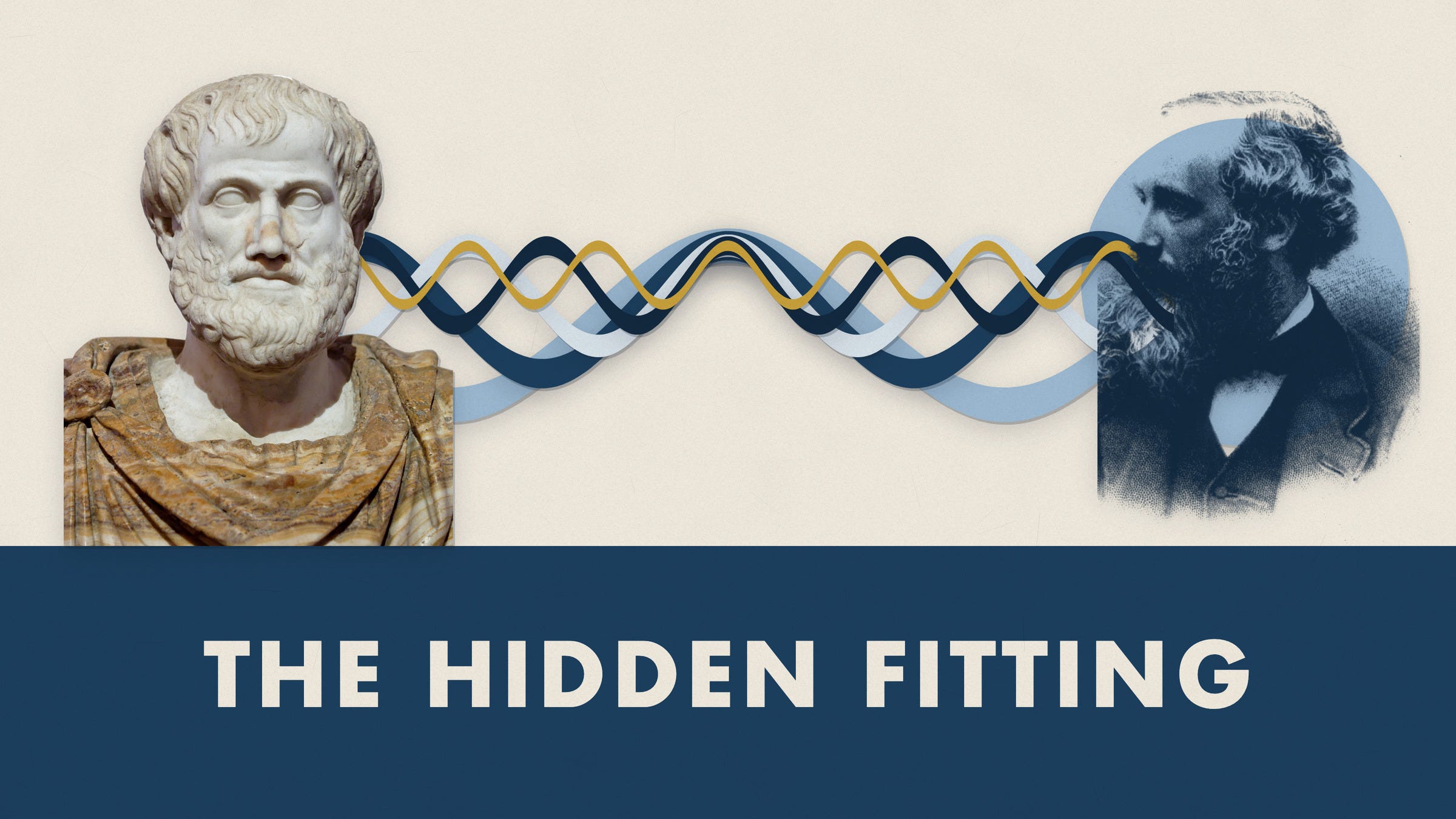
Two faces have already appeared in this series. One is the marble bust of Aristotle in Rome, with the blank eyes I wrote about in the fifth essay. The other is James Clerk Maxwell, bearded, looking off to one side, from the second. This week I did something to them.
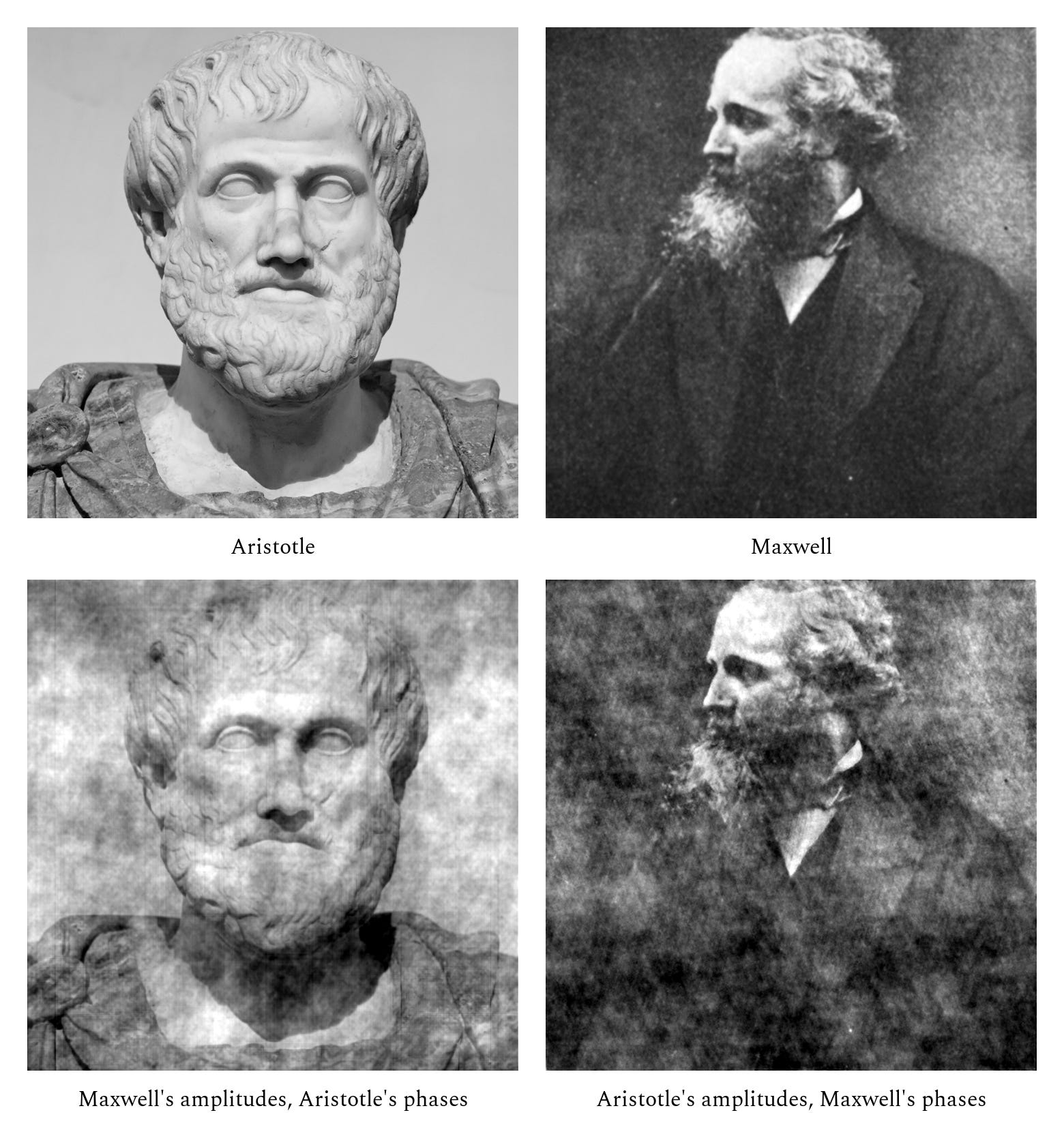
Any picture can be written as a sum of waves: broad, slow ones for the large shapes, fine, fast ones for the edges and the curls of a beard. Each wave carries two numbers. One is its amplitude, how strongly it is present. The other is its phase, where along the picture its crests fall. I took both portraits apart into their waves, kept every amplitude from Maxwell, and gave them Aristotle’s phases. Then I put the picture back together.
It is Aristotle. Grainy, washed over with a gray haze, but unmistakably the bust, down to the blank eyes. Do it the other way round, Aristotle’s amplitudes with Maxwell’s phases, and Maxwell comes back.
Where the crests fall
None of this is new. In 1981 Alan Oppenheim and Jae Lim, at MIT, published a long paper called “The Importance of Phase in Signals,” gathering a result their group had been demonstrating for a few years. In many situations, they wrote, keeping only the phase of a signal preserves many of its important features, and under some conditions, a signal of finite length among them, the phase alone is enough to rebuild it completely, up to a scale factor. A 1979 paper from the same group showed the other half. Keep only the amplitudes and you get “a small bright region near the origin” on a dark ground, with “no resemblance to the original image.”
The reason is easier to see than to say. An edge, the line of a nose against a background, is a place where many waves happen to crest together. The amplitudes say how much of each wave there is. The phases say where they agree. Move the agreements and the edges move with them, whatever the amounts.
The amounts tell you how much. The phases tell you who.
The hidden fitting
Hippolytus of Rome, writing against heresies in the early third century, quoted a sentence of Heraclitus as evidence that he praised the unseen and then, in turn, the seen. It is four words long:
ἁρμονίη ἀφανὴς φανερῆς κρείττων.
Charles Kahn translates it as “The hidden attunement is better than the obvious one.” Miroslav Marcovich has “Invisible connection is stronger than visible.” Edward Hussey goes furthest: “Latent structure is master of obvious structure.” The disagreement is about the first word. Before harmonia meant music, it was a craftsman’s word for the way pieces are fitted together, the joints Odysseus hammers into his raft in the Odyssey, and some scholars trace it back to Mycenaean Greek for a wheel held true by its spokes.
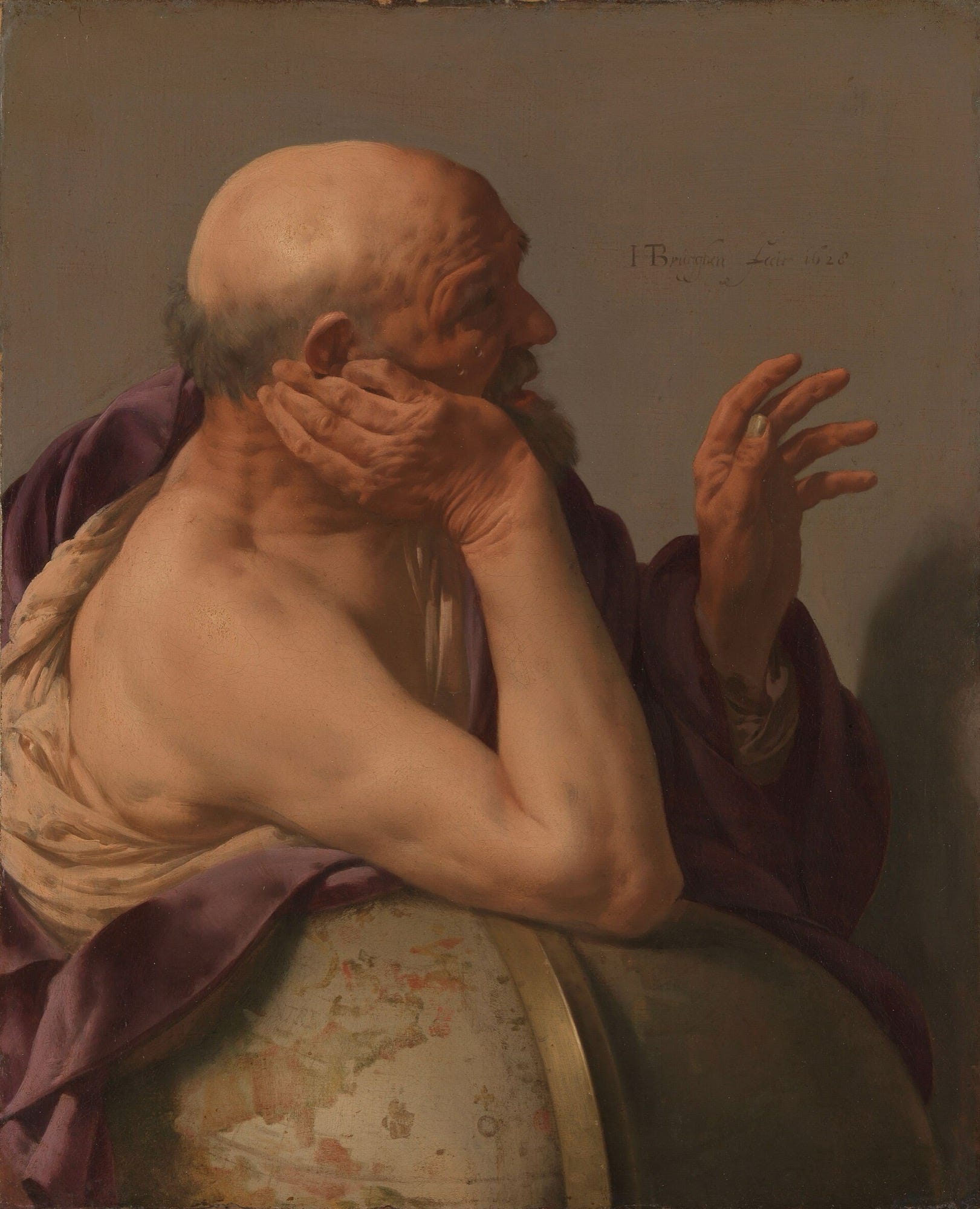
Heraclitus knew nothing about Fourier, and a fragment is not a theorem. But hold the line beside the figure. The amplitudes are what is obvious: there is this much fine detail, this much broad shading. The fitting is hidden in the phases, and the fitting decides whose face it is.
In the fifth essay I proposed that information is form in action, and I held it to a rule I had set earlier in the series: a reframing earns something only when it predicts what the old framing does not. I admitted it had not done so yet. Here is where I think it does.
How it would fail
In 2009 Niko Busch, Julien Dubois and Rufin VanRullen showed people flashes of light so faint that each person saw only about half of them, while recording their brain activity from the scalp. The flashes were identical. What differed was the brain: just before a flash, the phase of the slow rhythms already running in it, in the theta and alpha range, was different on the trials people saw from the trials they missed. Phase accounted for at least 16 percent of the variation. In 2019 Mireia Ruzzoli and colleagues set out to confirm effects of this kind with a design and a statistical power planned on the studies that had found them, and found that the amplitude of the alpha rhythm mattered but its phase did not. The question is open, and I would rather tell you that than pretend it is closed.
In September I published a paper with colleagues proposing that what a brain does with a rhythm depends on its phase structure more than on its power, because the membranes the rhythms run through act as interfaces where waves interfere. That is a hypothesis. The paper lists four ways to break it, and the one I care most about here is the simplest. In our words: “phase-scrambling with power preserved should abolish the predicted spectro-phase co-variation, a decisive negative control that fails if the co-variation persists.”
Phase scrambling is the portrait experiment run on a recording. You keep exactly how much of each rhythm there is and randomize where its crests fall. If information is something a signal contains, a quantity, then the pattern we predict should survive the scramble, because every quantity is untouched. If information is form in action, the pattern should vanish, because the arrangement was the form. If it survives, the proposal is wrong on its own terms, and I will have to say so here.
This is a test, not a result. Nobody should believe the idea because I have written down how it could fail. Writing it down is what makes it worth checking.
Go back to the figure. The face on the lower left is built entirely from Maxwell’s amounts, and still the blank eyes of the statue look out of it. Aristotle said an eye that cannot see is an eye only in name. This one cannot see either. But it is recognizable for one reason only: where the crests fall.
Further reading:
Oppenheim, A. V., & Lim, J. S. (1981). The importance of phase in signals. Proceedings of the IEEE, 69(5), 529-541. https://doi.org/10.1109/PROC.1981.12022
Oppenheim, A. V., Lim, J. S., Kopec, G., & Pohlig, S. C. (1979). Phase in speech and pictures. ICASSP ‘79, IEEE.
Gabor, D. (1948). A new microscopic principle. Nature, 161, 777-778. https://doi.org/10.1038/161777a0
Busch, N. A., Dubois, J., & VanRullen, R. (2009). The phase of ongoing EEG oscillations predicts visual perception. Journal of Neuroscience, 29(24), 7869-7876. https://doi.org/10.1523/JNEUROSCI.0113-09.2009
Ruzzoli, M., Torralba, M., Morís Fernández, L., & Soto-Faraco, S. (2019). The relevance of alpha phase in human perception. Cortex, 120, 249-268. https://doi.org/10.1016/j.cortex.2019.05.012
Firaux, T., et al. (2026). Beyond representations: from active inference to active interference. Frontiers in Human Neuroscience, 20, 1925538. https://doi.org/10.3389/fnhum.2026.1925538
Heraclitus, DK 22 B54, in Hippolytus, Refutatio IX.9.5. Translations: C. H. Kahn, The Art and Thought of Heraclitus (1979); M. Marcovich, Heraclitus (2001); E. Hussey, The Presocratics (London, 1995), p. 35, as cited by Afonasina. On harmonia: A. Afonasina, “The birth of harmony out of the spirit of tekhne,” ΣΧΟΛΗ 6.1.
Earlier in this thread
You Are Not a Closed System

A woman crying in a parking lot. Engine off, hands still on the wheel. The kind of crying that has no audience.
What a Bit Actually Is

On a Saturday evening in February 1946, a new program went out on the Mutual Broadcasting System from a theater on West 48th Street in New York. Four panelists. One hidden object, mailed in by a listener. Twenty questions, each answerable only yes or no. The show was called Twenty Questions, and it ran, in one format or another, for the better part of a…