



A woman crying in a parking lot. Engine off, hands still on the wheel. The kind of crying that has no audience.
A long table, open bottles, the meal long finished. Someone laughing so hard they go silent, mouth open, no sound, tears forming for a completely different reason than the woman in the parking lot.
A runner at the fortieth kilometer. The body has crossed a threshold it did not know existed. Something else has taken over.
Seventy thousand people singing the same word at the same moment. None of them decided to. It simply happened, like a wave that no single water molecule chose to become.
What do they have in common?
The obvious answer: emotions. The brain. Human experience in its most intense form.
But there is another answer. One that does not contradict the first.
They are physics.
The 20% engine
The brain weighs about 1.4 kilograms. It accounts for roughly 2% of body mass. Yet it consumes nearly 20% of the body’s total energy, and it never fully switches off. Even at rest, it burns through glucose at a rate that would exhaust most tissues within minutes.
The laws of thermodynamics apply here without exception. Energy is neither created nor destroyed, it changes form. Heat, work, dissipation. The brain is a system that takes in energy and continuously transforms it, maintaining itself far from equilibrium.
But a heat engine does not cry in a parking lot. It does not synchronize with seventy thousand strangers. It does not feel the fortieth kilometer as something other than damage.
The physics is real and it is not enough. Or rather: maybe it is pointing toward something deeper than we usually allow it to.
Think of two violins. Same note, same frequency. The wood is different, the age is different, the history of the instrument is different. The resonance is different.
The material is not incidental to the sound, the material is the sound.
The brain has a material too. And that material changes everything.
Where does the physics end?
Energy does not disappear inside the brain. It changes form, continuously. Mitochondria convert glucose into electrical activity. Electrical activity propagates across membranes. Membranes generate fields. Fields couple to other fields.
Nothing is lost. Everything is transformed.
But here is what classical physics missed for a long time: a living system is not a closed engine running down toward equilibrium. It is an open system that maintains itself precisely because it dissipates. The brain is not alive despite the constant flow of energy through it, it is alive because of it. Order sustained by throughput. Structure built from flux.
This changes what we mean by stability.
Imagine a spinning top. It does not stand still, it oscillates, it wobbles, it traces small circles around a center it never quite reaches. It stays upright not through rigidity but through movement. The stability is dynamic, not static.
The brain works the same way. Researchers studying whole-brain dynamics have found that the optimal condition for cognition is not order and not chaos, it is the edge between them. A state of perpetual near-transition, where the system is always ready to shift configuration without ever collapsing into noise. Metastability: the technical name for a system that lives in the tension between settling and dissolving.
Think of attractors as valleys in a landscape. The system rolls toward them naturally, but the landscape itself is alive, shifting, redrawn by every experience. There is no fixed bottom. There is only the current shape of the terrain.
A flame, not an engine
A hundred years ago, in a short text he never published, Sigmund Freud tried to derive a Newtonian mechanics of the brain. He called the governing principle neuronal inertia. He had trained in the school of Helmholtz and Brücke, physicists who believed that living organisms obeyed the same laws as everything else in nature. He took that seriously.
The intuition was correct. He lacked the instruments to measure what we are only now beginning to see.
What Freud was missing was the thermodynamics of open systems, the understanding that life does not minimize energy, it organizes it. He treated the mind like a closed engine, pressure building until it found release. But a living system is not a closed engine. It is a flame, it does not wind down, it sustains itself through continuous flow.
The top does not stop spinning. It learns to spin differently.
The science caught up with the intuition. It just took another century.
The patterns do not stop at the skull
In the research we are developing with Marco Cavaglià and Jack Tuszynski, the membrane is not a wall.
Think of skin. Skin is not where the body ends, it is where the body meets the world. A surface that breathes, senses, regulates, remembers contact. A boundary that does not separate so much as translate.
The membranes inside the brain do the same thing, at a different scale. They are where information becomes body. They write and read. They store and retrieve. Everything the system can say passes through them.
Now picture something else entirely.
Two stones dropped into a still lake.
Each creates its own pattern of waves, expanding rings, crests and troughs radiating outward. When the two patterns meet, they do not simply add together. They interfere. Where crests align, the water rises higher. Where crest meets trough, they cancel. What emerges is not the sum of two separate patterns, it is something new, a structure that belongs to neither stone alone.
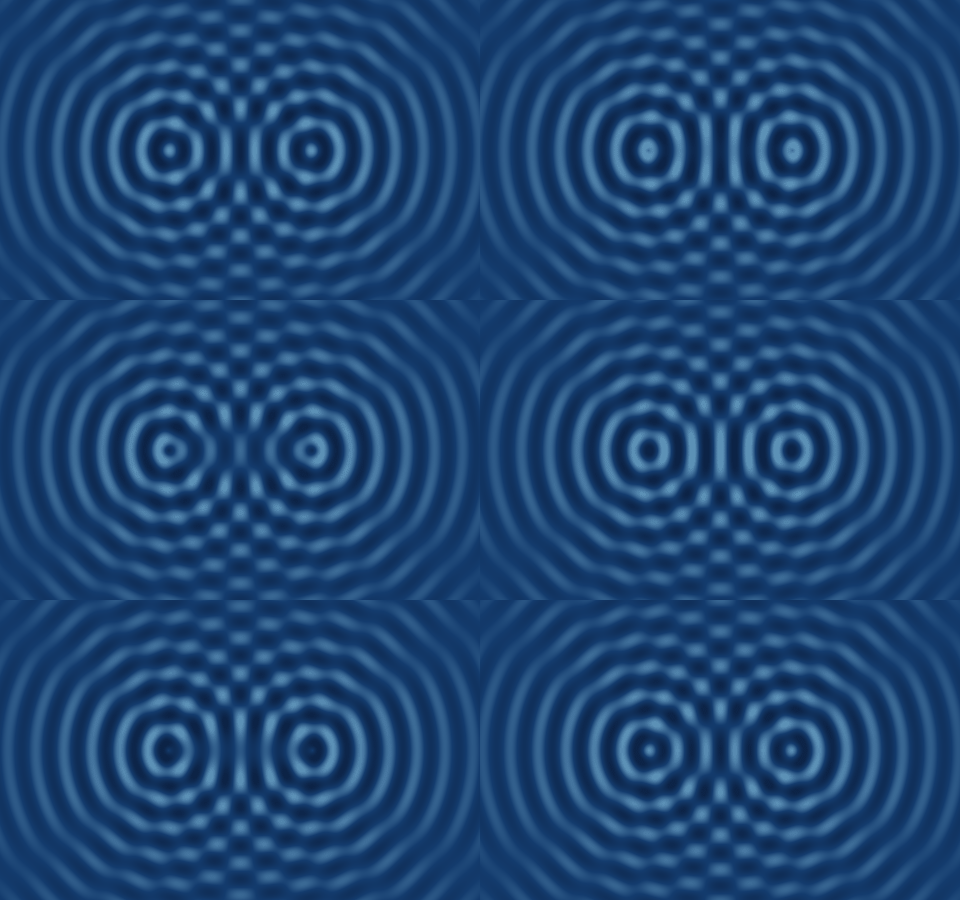
This is not a metaphor for what happens between two nervous systems in the same space. It is the mechanism.
Two people in a room are not isolated systems exchanging signals. They are oscillating fields coupling at their boundaries, membranes responding to membranes, rhythms entraining rhythms, phase patterns writing themselves onto phase patterns. The interference is physical. It happens whether or not either person is aware of it.
Energy, mass, and information form a continuous loop across scales. What begins as molecular oscillation at the membrane interface propagates upward, through electrical fields, through the body’s geometry, through the space between bodies. The loop extends itself out of the skull.
This is measurable, at least at small scales. When two people engage in genuine interaction, conversation, collaboration, shared attention, their neural oscillations synchronize in ways that exceed chance. Electroencephalography can record it. The coupling is real, it is directional, and it scales with the quality of the interaction.
Whether the same physics scales up to seventy thousand people in a stadium is a question the data has not yet answered. But if it does, the concert is not just an image. It is a phase transition, a collective configuration that none of them could produce alone, that exists only in the interference between them.
The physics did not end. It was just larger than we thought.
A woman crying in a parking lot. A standing wave in a body that looks still.
A long table, open bottles, someone laughing so hard they go silent. Interference at the edge of dissolution.
A runner at the fortieth kilometer, the body past itself. Energy finding a configuration it had not known.
Seventy thousand voices, one word, one moment. A phase no single throat can produce.
Not four human experiences. Four physical configurations in relation. Four sets of interference patterns writing and reading each other across the boundaries between systems.
The energy was always there. The mass was always there. The information was always there, not just inside any one of them, but between them, in the structure that emerged from their relations.
Further reading
Cavaglià, M., & Tuszynski, J.A. (2026). A Unified Holographic Framework for neural computation and consciousness: From lipid membranes to the Schumann resonance. BioSystems, 259, 105669. https://doi.org/10.1016/j.biosystems.2025.105669
Firaux, T., Tuszynski, J.A., & Cavaglià, M. (2026). EMI model: A scale free biophysical framework for human consciousness, cognition and behaviour. BioSystems, 259, 105674. https://doi.org/10.1016/j.biosystems.2025.105674
Deco, G., & Kringelbach, M.L. Whole-Brain Modelling: Cartography of the Dynamics of Mind. Oxford University Press. https://academic.oup.com/book/62453
Cieri, F. (a cura di). (2022). Neuroscienze Psicodinamiche. Verso il superamento di una mindless neuroscience e di una brainless psychoanalysis. Milano: FrancoAngeli.
Freud, S. (1950 [1895]). Project for a Scientific Psychology. In The Standard Edition of the Complete Psychological Works of Sigmund Freud, Vol. 1, pp. 283-397. London: Hogarth Press.
Your open‑system stability aligns with my work: coherence as a pattern that survives through continuous correction. The boundary between the systems supports the coupling. The relational field is part of the mechanism. Great article!