


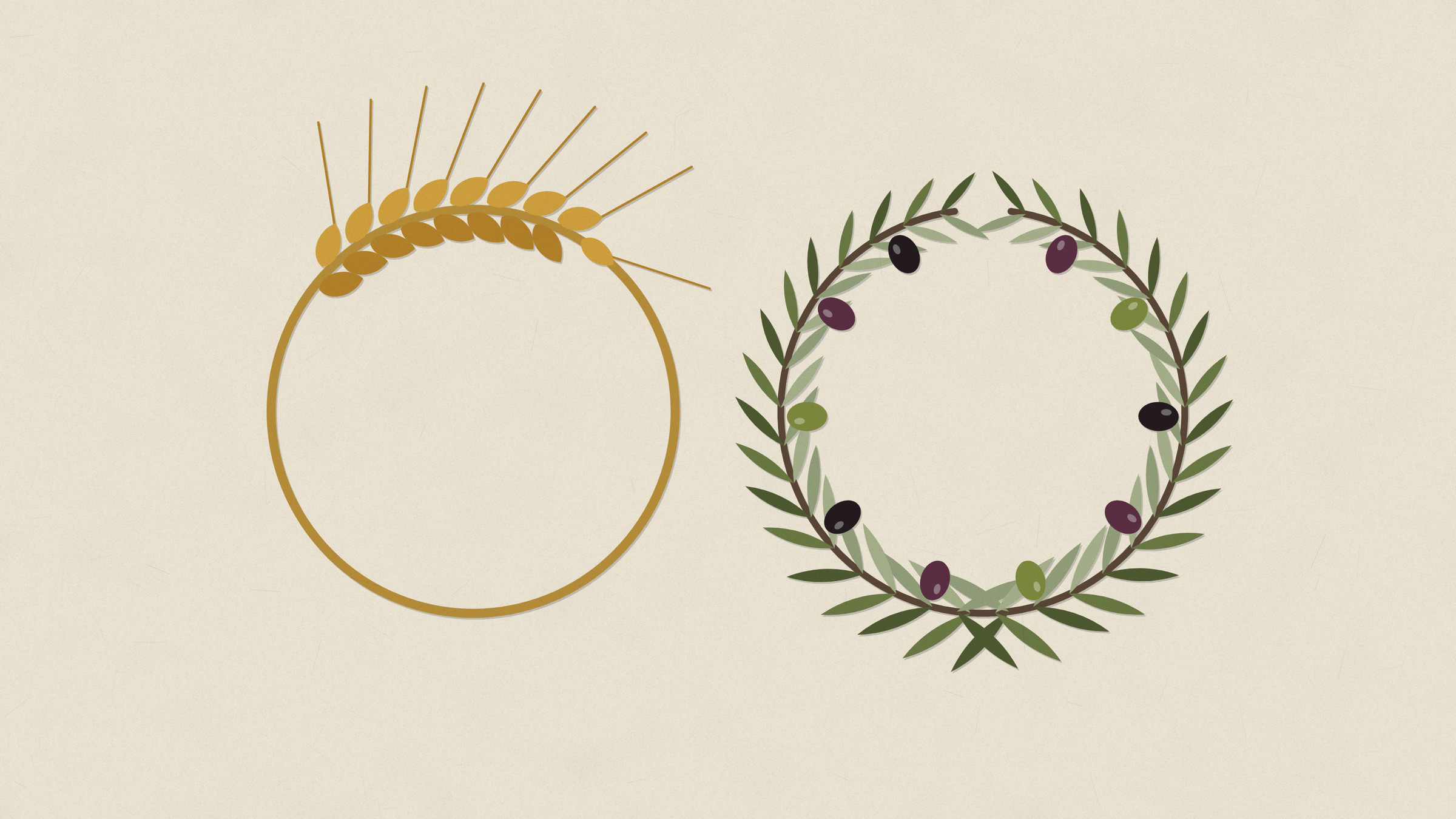
By early summer a wheat field turns the same color everywhere at once. Every plant in it came up in the same season and flowered in the same few weeks, and each one will set its seed and die before the field is cut. Pick any grain from the harvest and ask how old the plant that made it was. You already know the answer, and it is the same for every grain.
At the western end of Crete, in the village of Ano Vouves, there is an olive tree you can see through. Its trunk has hollowed out from the inside, and the wood that might have kept count of its first years has gone with it, so where its beginning should be there is daylight, and nobody can say how old it is. Estimates of its age start at two thousand years and run past four thousand. It still bears olives.
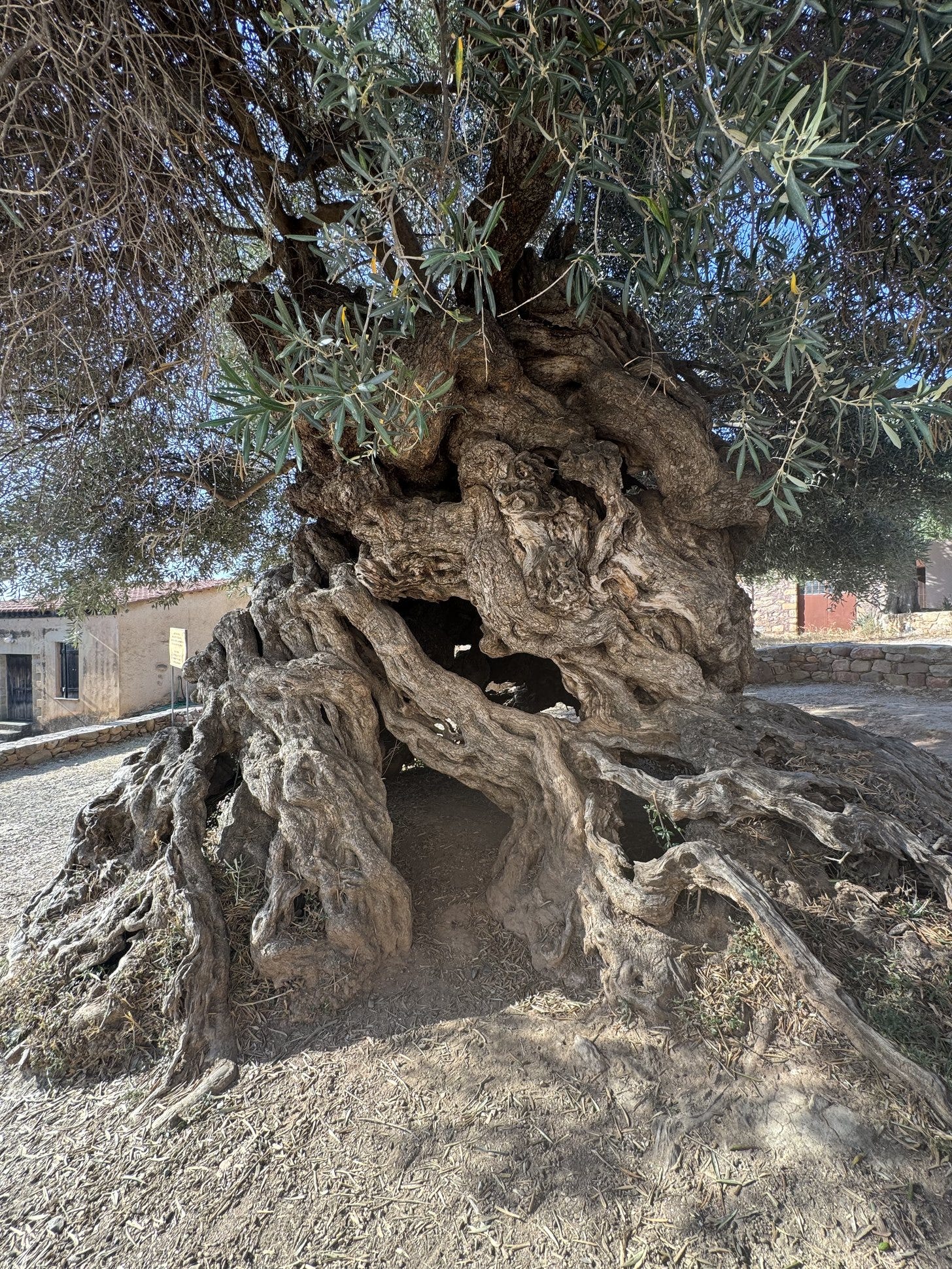
Ask the same question among olive trees and the answer changes with every fruit. The tree that made this olive might be thirty years old. The one beside it might be three hundred.
A count with a clock in it
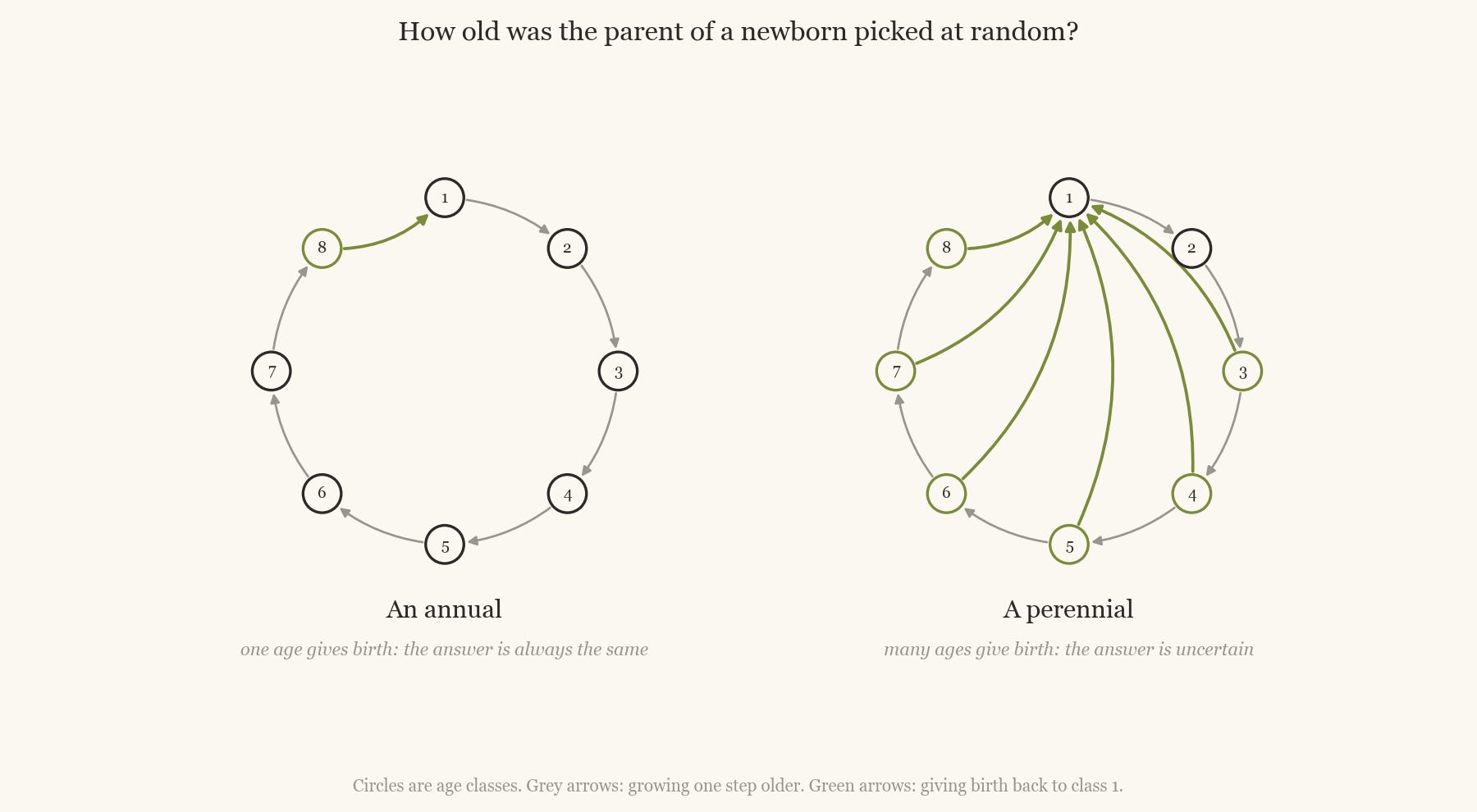
Last week ended with a question: what is entropy counting, when what it counts is not grains in a glass, but lives? The most exact answer I know belongs to Lloyd Demetrius, a mathematical biologist who has spent fifty years on it. In 1974 he introduced what he called the entropy of a population, and the version he later named evolutionary entropy measures the uncertainty in exactly that question: pick a newborn at random, and how old was its parent?
For the wheat, the uncertainty is zero. Demetrius uses the example himself: annual plants, which reproduce at a single stage of life, have zero entropy; perennials, which spread reproduction across many ages, have positive entropy. The measure belongs to a population and never to one plant, so the Vouves olive has none of its own. A population of wild olives has it. So does a town.
The mathematics is what keeps this from being a rename. Boltzmann’s entropy counts the ways a system can be arranged at an instant. Demetrius took his from ergodic theory instead, from the measure Kolmogorov and Sinai built in the 1950s for how unpredictable a trajectory is as it unfolds. His trajectory is a genealogy, a chain of parents running back through time, each at the age they were when the next was born. In his 2024 paper he puts the difference in two words. Thermodynamic entropy measures a “positional” ordering, evolutionary entropy a “temporal” one.
The glass counted where things are. The olive counts when.
Divide the same quantity by the generation time and it measures something the glass never had: how quickly a population finds its way back to its steady state after a small disturbance. On Demetrius’s mathematics, a population that puts all its births into one season scores zero on this measure, and one that spreads its births across decades finds its way back faster.
Heat cannot pay for a cell
Why does life need a different entropy at all? His 2024 argument starts from something any engineer knows: heat does work only by flowing from hot to cold, and the most work you can get from it grows with the temperature difference. A cell has almost no temperature difference inside it, so heat can do almost no work there. Life pays in other currencies, energy held in chemical bonds, electrons handed from molecule to molecule, light caught by a pigment, concentrations held unequal across a membrane.
A measure built for heat moving through a gas is, he argues, the wrong ledger for a living thing.
Then comes the part he calls the Entropic Principle of Evolution. In its simplest form: where the source of energy is stable, mutation and selection push evolutionary entropy up; where it fluctuates, they push it down. Steady resources favor lives that spread themselves across time, and boom and bust favors lives that spend themselves at once. In his models this is a derived result. Whether real populations follow it is a question for data, and the cases he and colleagues have published are consistent with it, which is not the same as settling it.
Inside a cell, heat can do almost no work. Life has to pay in something else.
In the same paper he goes further, onto softer ground. He argues that the second law of thermodynamics is a limiting case of his principle: let the parts vary only by chance fluctuation, close them off from any input of energy and matter, let their number grow without limit, and what remains is Boltzmann’s law. If that holds, and it is a large if, the second law is not the rule life breaks but a special case of the rule life follows.
It would be easy to stop there. The paper presents no new data; it is a theoretical reading of how the pieces fit. Directionality theory, as Demetrius calls the whole framework, has stayed outside the mainstream of evolutionary biology, where fitness is still mostly measured by how fast a population grows. I find the mathematics beautiful and the large claim unproven, and I want to hold both.
Long movement
Last week I ended on the second line of chapter fifteen of the Dao De Jing, and it is worth hearing again now: 孰能安以久動之徐生, who can take what is at rest and, by long movement, slowly bring it to life?
Laozi was not doing demography, and nothing in Demetrius depends on him; a resemblance is not evidence. Still, set the line beside the two plants and the words Demetrius’s measure would underline are the slow ones. Long. Slowly. The wheat gives everything once. The olive keeps giving, year after year, from a body that has lost its own beginning.
Go back to Vouves. The tree has outlived its heartwood, the part that would have told us when it started, and kept the part that keeps it going. Someone picking olives there this autumn will hold this year’s fruit from a tree nobody can date
Further reading
Demetrius, L. A. (2024). Directionality theory and the origin of life. Royal Society Open Science, 11, 230623. https://doi.org/10.1098/rsos.230623
Demetrius, L. (1997). Directionality principles in thermodynamics and evolution. Proceedings of the National Academy of Sciences, 94(8), 3491-3498. https://doi.org/10.1073/pnas.94.8.3491
Demetrius, L. (1974). Demographic parameters and natural selection. Proceedings of the National Academy of Sciences, 71(12), 4645-4647. https://doi.org/10.1073/pnas.71.12.4645
Dao De Jing, chapter 15, in the received text of Wang Bi (226-249).
Earlier in this thread:
Still Water Is Not a Quiet Mind

It is three in the morning and your mind will not settle. The afternoon’s conversation plays again, with better lines this time, and behind it come the email you forgot to send and a number that still does not add up. Nothing arrives in order. It all comes up at once, like silt kicked up from the bottom of a glass, and hangs there in the dark.
The Same Equation Twice

There is a cemetery in Vienna where the composers draw visitors all year. Beethoven, Brahms, Schubert, a Strauss or two. A short walk from them, in a quieter row, stands a headstone with a bust on top and something carved beneath it that nobody puts on a grave.
Tommaso, I find something rather wonderful about a tree that has outlived the very wood that could tell us how old it is, yet continues producing fruit. Imagine everything that has happened around it over the centuries, while it just keeps doing what olive trees do!
I also appreciate your distinction between finding a theory beautiful and considering it proven. There's plenty of room for intellectual curiosity without insisting we have all the answers.