


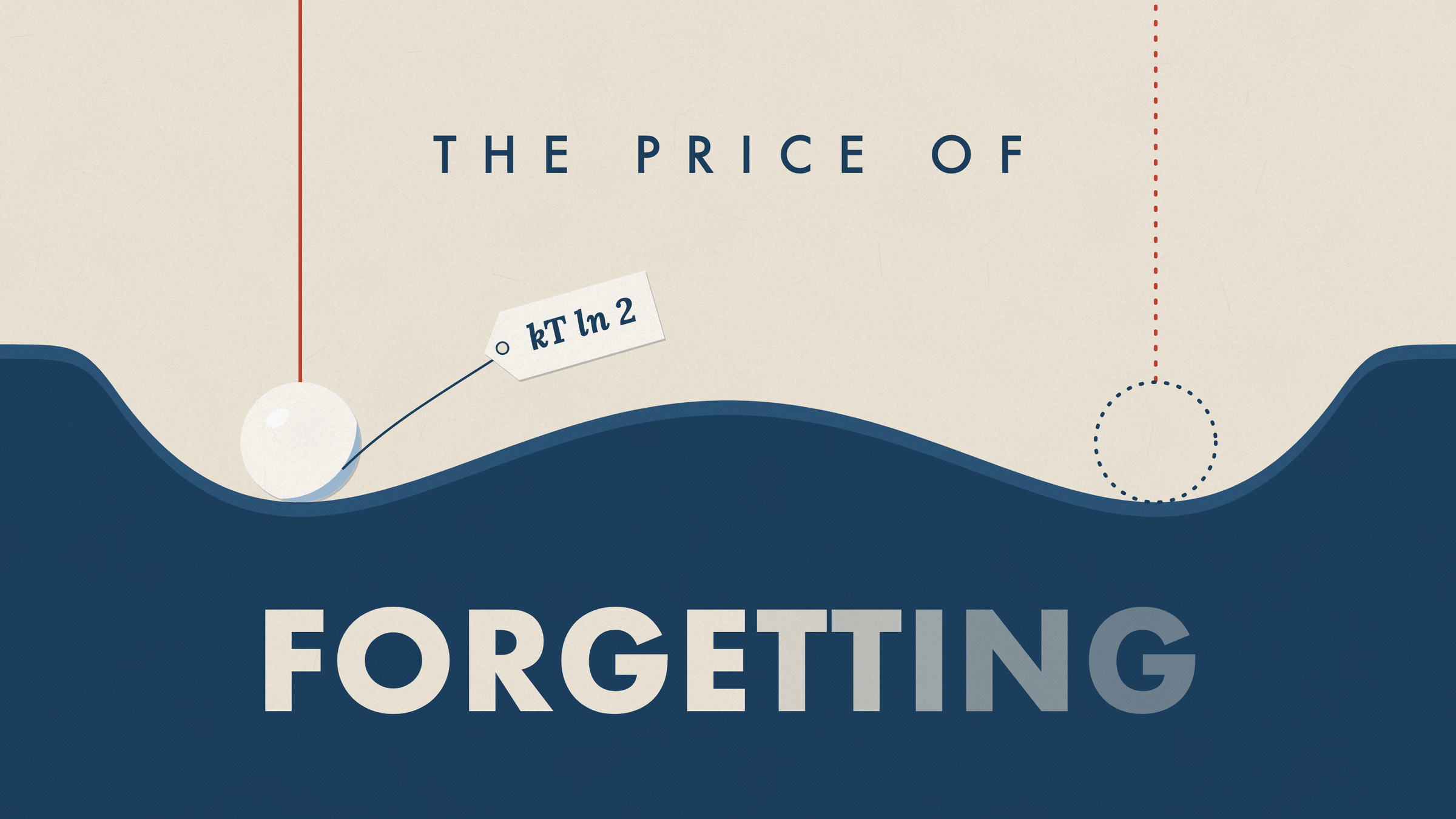
In a laboratory in Lyon, in 2012, a group of physicists built the smallest memory anyone had ever built, and then measured what it costs to wipe it.
The memory was a single glass bead two micrometers across, suspended in water and held by a laser. By flicking the laser between two nearby points fast enough, they made a landscape with two valleys and a hill between them. The bead sits in one valley or the other. Left or right. That is the entire device: one bit, made of one bead.
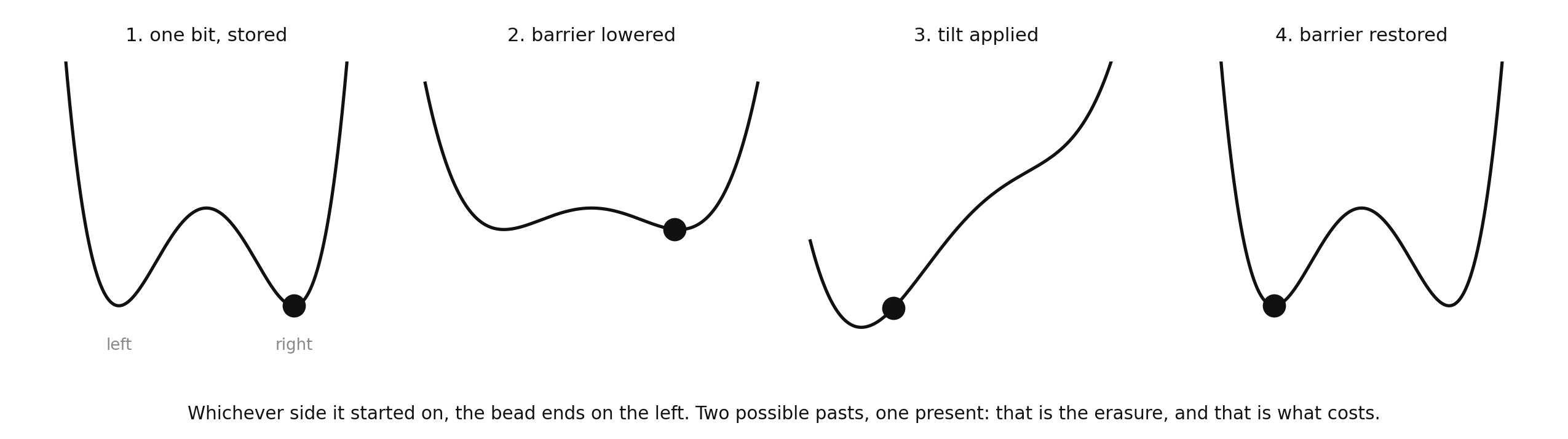
Then they erased it. They lowered the hill, tilted the landscape so that the bead ended up on the left whichever side it had started on, and put the hill back. Whatever had been written was gone. And because the bead was in water and they could watch it, they could add up the heat that went into the water while it happened.
The number they were looking for is about three thousandths of a billionth of a billionth of a joule. Small enough that nothing in ordinary life would ever notice it. Not zero, which is the whole point.
The bill nobody was looking for
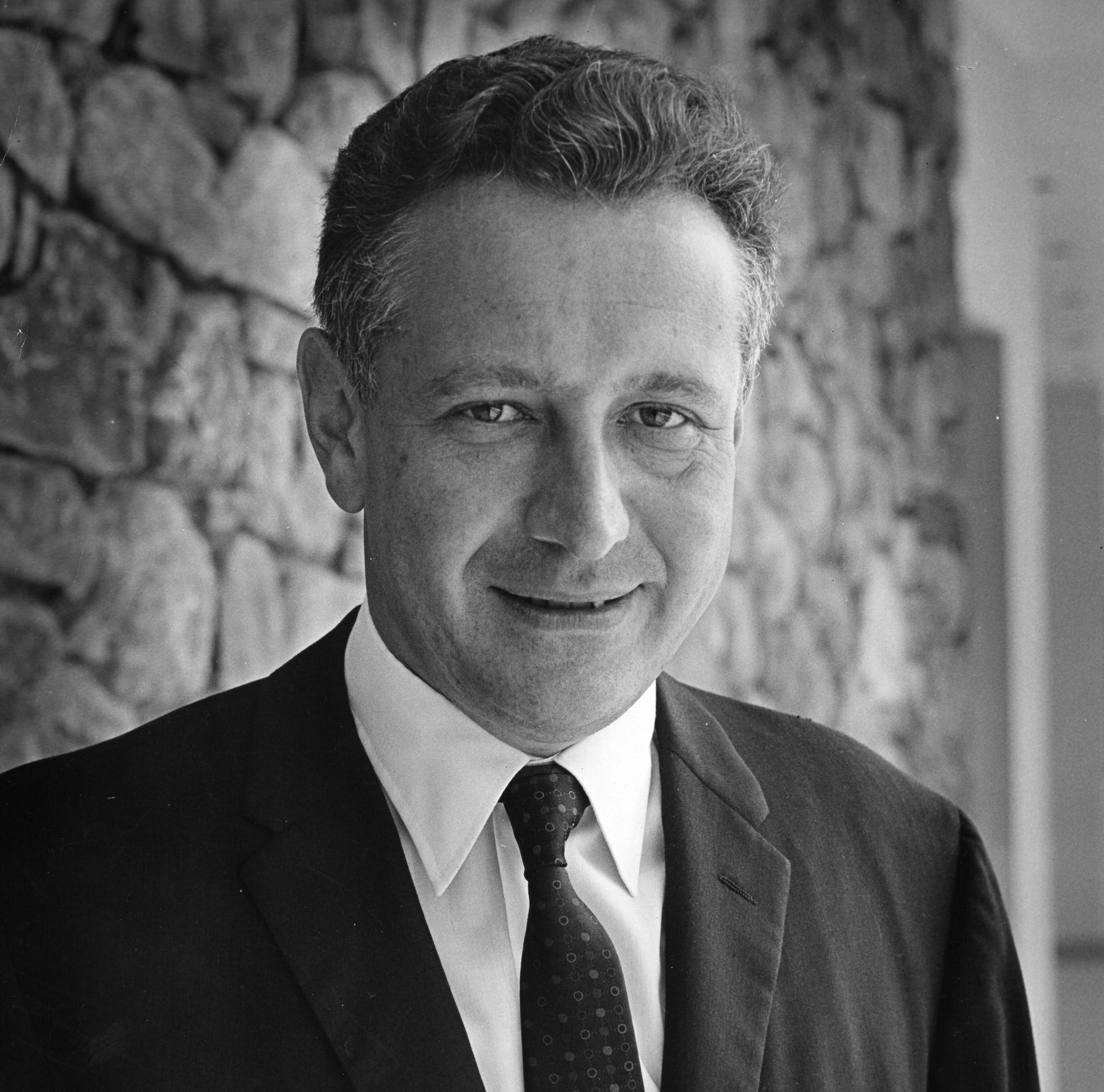
That number came from a paper written fifty years earlier by a man at IBM who wanted to know whether computing has a physical floor.
In 1961 Rolf Landauer published “Irreversibility and heat generation in the computing process.” The question was not whether better engineering could reduce the power a computer draws. It was whether the manipulation of information has any minimum cost at all, in principle, that no cleverness could get under.
His answer was that most of it does not. You can add, copy, and route, in principle, for nothing. But one operation is different, and it is the one nobody thinks about.
Erasing.
Almost every operation in a computer can be run backwards. Told the output of a copy, you know the input. Erasure cannot. “Set this bit to zero” takes a one and returns zero, and takes a zero and returns zero. Two different pasts, one present. Told that the answer is zero, you cannot say what was there before.
That compression is not an inconvenience, it is a physical event. The system had two possible states and now has one. Phase space does not simply lose volume: something has to expand to compensate, and what expands is the surroundings, warmed by at least kT ln 2 per bit destroyed.
Information is physical.
The correction
Two essays ago I left Leo Szilard in 1929, concluding that the demon survives the second law because its measurement must cost something. Knowing, he said, cannot be free.
He was right that the books balance. He was wrong about where.
In 1982 Charles Bennett showed that measurement can be made thermodynamically reversible. The demon can look at a molecule, register which side it is on, and pay nothing in principle. For half a century physicists had been guarding the wrong door.
The trick is that looking, done carefully, adds no information to the world. It correlates two things that were already there. If the demon’s memory starts in a known blank state and ends up matching the molecule, nothing has been destroyed: run the interaction backwards and the memory returns to blank, the molecule to wherever it was. Nothing about that is forbidden. It is bookkeeping, not creation.
What the demon cannot do is keep looking forever. Every observation writes something into its memory, and no memory is infinite. Sooner or later, to carry on working at all, it has to clear the record and begin again.
That is when the bill arrives. Not at the seeing. At the forgetting.
I find this the strangest result in the whole sequence, and I have been sitting with it for a long time without getting used to it. The universe does not charge you for looking. It charges you for letting go.
What the number licenses
Last week I set a criterion, and it applies here first. A shared form is evidence that two things are one thing only when treating them as one predicts something that treating them as two does not.
This is that case. If thermodynamic entropy and information entropy were genuinely separate quantities that happen to share a formula, then erasing one bit of memory would carry no particular thermodynamic price, and the heat measured in Lyon could have come out at any value at all. Treating them as one quantity predicts a specific floor. The heat settled onto that floor as the erasure was performed more and more slowly, exactly as the theory requires.
So the identity earns something here. Not a metaphor, not a coincidence of notation. At one point at least, an informational fact about a system predicted a thermodynamic measurement, and the measurement agreed.
Now the part where I would rather be careful in front of you than caught out later. What was established is a lower bound on the heat released by a logically irreversible operation in a system at thermal equilibrium. It is not a theory of mind. It does not show that thinking is computing. It says nothing about whether your brain is paying Landauer’s bill in any way that matters, and anyone who tells you otherwise has skipped several steps that have not been taken.
What it does establish is smaller, firmer, and enough to be going on with.
Forgetting has a price. The price is in joules. Somebody has measured it.
“The universe does not charge you for looking. It charges you for letting go.”
Well, there's a sentence I'm going to be thinking about for the rest of the day.
I also really appreciated that you didn't try to turn the physics into some grand theory of human memory. The actual result is strange and wonderful enough on its own.