


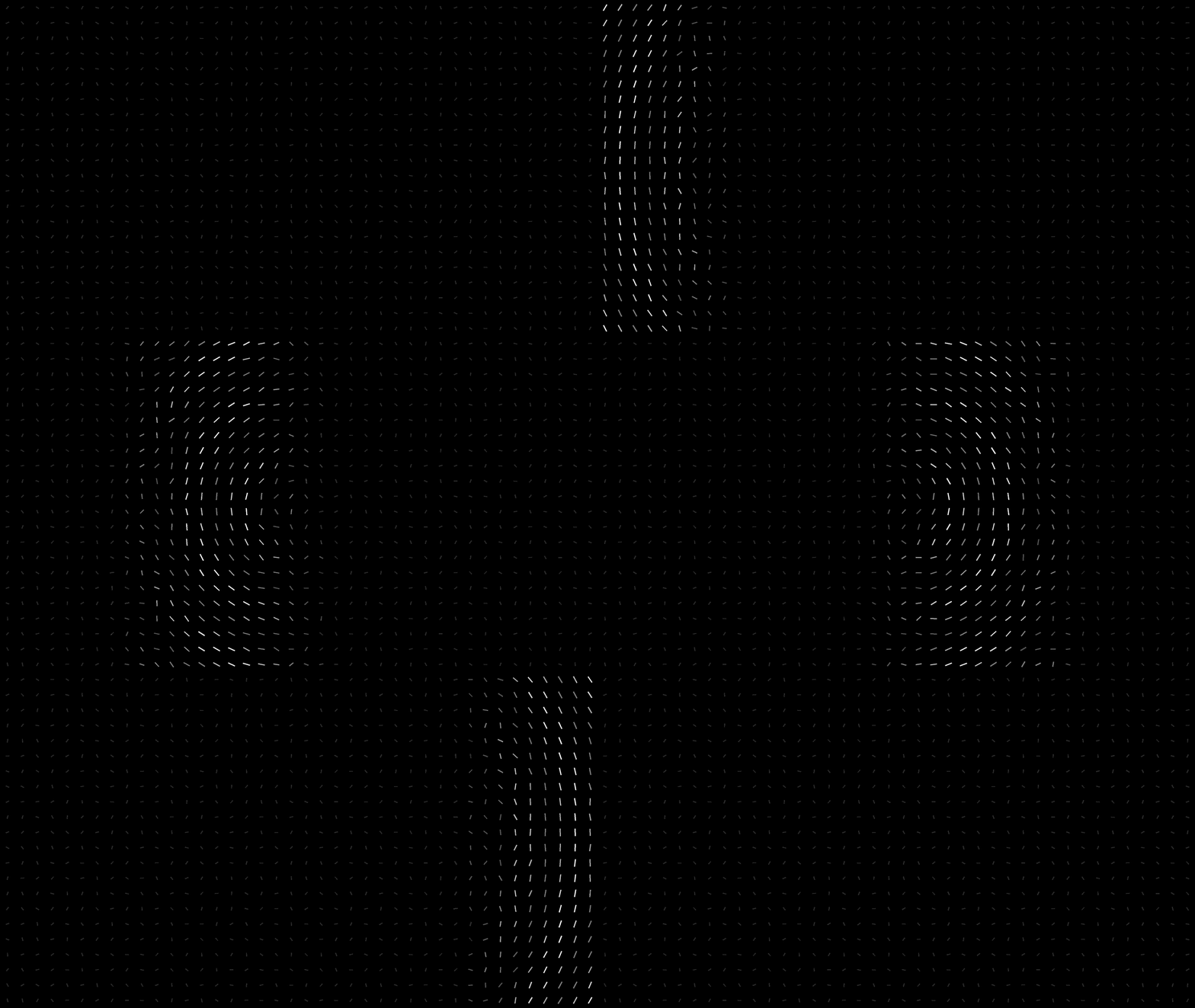
A developed hologram is a disappointing thing to look at. Vittorio and I wrote about one this week, the plate Dennis Gabor dreamed up in 1947 while waiting for a tennis court, and what we did not dwell on is how little there is to see once it comes out of the developer. A sheet of glass gone grey, like breath on a window. Nothing you would think to frame.
Now put it in a drawer.
Where is the picture?
It is not in the glass, not in any sense you could point to. The plate recorded only the quarrel between two beams of light, one that bounced off the object and one that did not, and a quarrel does not look like either party. The picture stands up again only when the clean beam is sent back through, and then it stands in the air behind the plate, exactly where nothing is. In the essay we put it this way: information “is not carried from place to place but takes shape where it is.”
I want to take that sentence further than a hologram, because I think it is what this whole series has been circling.
A somewhat heady draught
In March 1956 Claude Shannon published a single page in the journal of his own field. It is called “The Bandwagon,” and it reads like a host asking the party to turn the music down.
Eight years after his paper, information theory was everywhere. Biologists, psychologists and economists were all applying it, and Shannon wrote, dryly, that the field was “partaking of a somewhat heady draught of general popularity.” Then the warning. It would be all too easy, he wrote, for the whole thing to collapse “when it is realized that the use of a few exciting words like information, entropy, redundancy, do not solve all our problems.” Applying the theory elsewhere was “not a trivial matter of translating words to a new domain.”
Warren Weaver had warned in 1949 that information “must not be confused with meaning.” We confused it anyway, and the confusion I care about is quieter than that one. Somewhere between the telephone wire and the present, information became a substance. We talk about it the way we talk about grain: it is stored, shipped, leaked, owned, and it sits inside things waiting to be taken out.
Read back through the last four essays and notice that it never once behaved that way.
Shannon’s bit was a measure of choice, how much an answer narrows down what it could have been, which means it needs someone, or something, for whom the alternatives exist. Maxwell’s demon, in Szilard’s hands, turned out to have a knower inside the second law, and when Landauer and Bennett finished the accounting, the bill fell not on the knowing but on the forgetting: an event, two possible pasts becoming one present, measured on a bead in Lyon. Landauer’s slogan was that information is physical, which is not the same as saying it is a thing.
A physicist working today has pushed the same way. In 1996 Carlo Rovelli proposed reading quantum mechanics as a theory that describes “only the information that systems have about each other.” Twenty years later he went back to Shannon and argued that the purely physical notion of information in that work would be better called correlation: “downright crude physical correlation.” Relational quantum mechanics is one contested interpretation among several, but on his reading information is never inside a system. It is between two.
And every time it turned up in this series, it was doing something.
The eye of a statue
On a January evening in 1970, the anthropologist Gregory Bateson gave a lecture in memory of Alfred Korzybski and borrowed a piece of chalk from Kant. Around and within it, he said, there is an infinite number of differences; “of this infinitude, we select a very limited number, which become information.” Then the definition everyone quotes, rarely in full. Information is “a difference which makes a difference,” and it is able to make one, he went on, because the pathways it travels along “are themselves provided with energy.”
That last clause usually gets dropped. It is the part I need.
It sends me back much further, to a word Aristotle put at the center of his philosophy. Energeia, built on ergon, work. The translator Joe Sachs renders it, deliberately literally, as being-at-work. It is the word for a thing being what it is by doing it, and it is the root, two thousand years later, of our word energy.
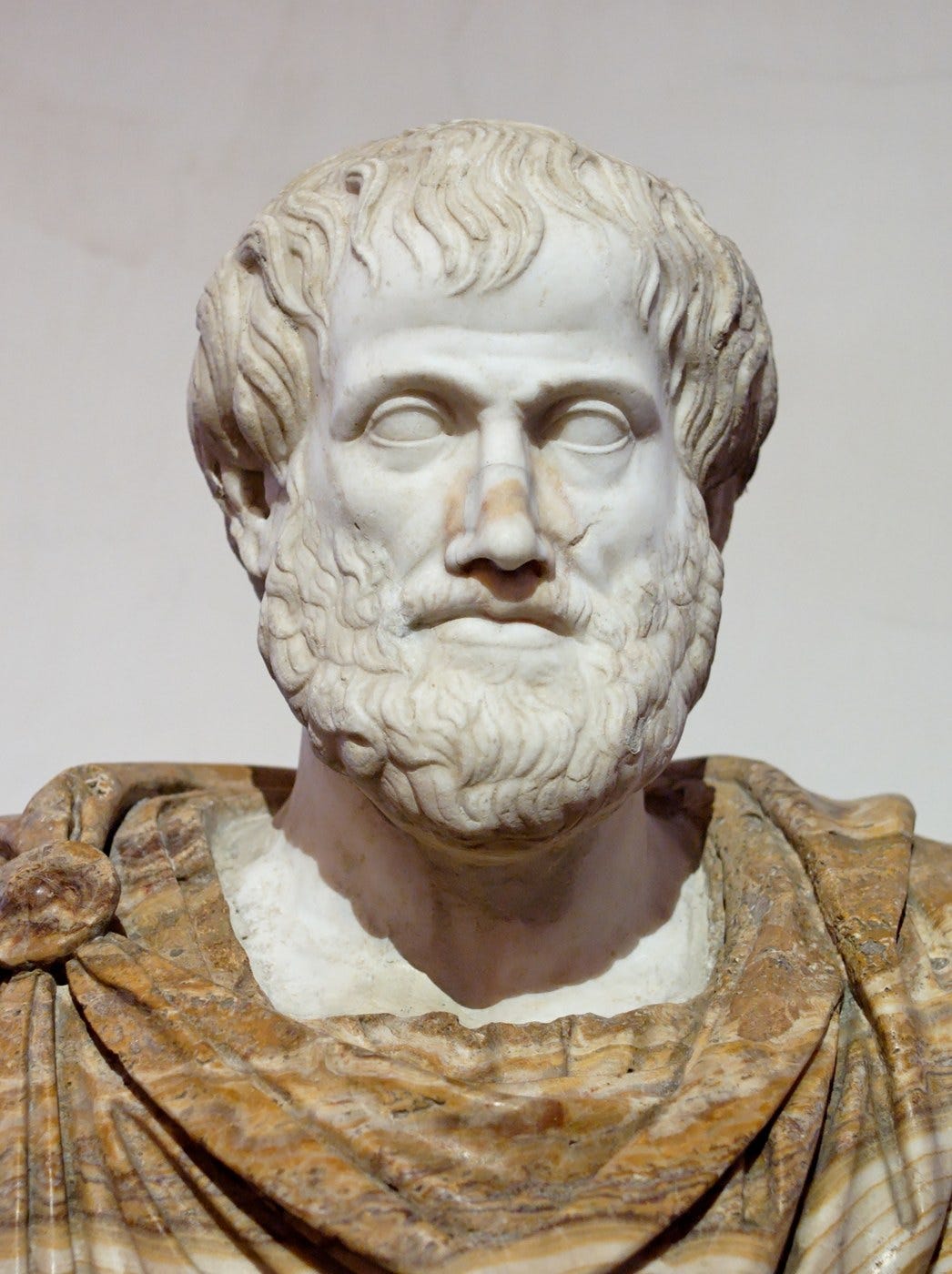
Aristotle’s clearest example is in the second book of On the Soul. Suppose, he says, that the eye were an animal. Then sight would be its soul. And when the seeing is taken away, the eye “is no longer an eye, except in name,” no more a real eye than the eye of a statue.
The plate in the drawer is the eye of a statue.
In the first essay of this series I went back to the Latin under our word: informare, to give form, the way a hand shapes clay. Put that beside energeia and you have the phrase I have been working toward since then without writing it down.
Form in action.
I want to propose that this is what information is: not a shape stored in a medium, but a shape at work in something it changes. Rovelli puts information between two things. What I would add is the verb.
Information is not simply something that is. It is something that is done.
A proposal, then, and I should hold it to the rule I set in this series two weeks ago: a reframing earns something only when it predicts what the old framing does not. This one has not done that yet. For now it is a way of standing in front of the evidence that fits four essays better than information as grain. Whether it tells you where to look is work still ahead of it, and you are entitled to ask me for it.
The third word
The first essay in this series ended by naming where it was going, four essays on: Energy, Mass, Information. This is the fourth since.
Energy comes from Aristotle’s being-at-work. Information comes from the Latin for giving form. And in the same chapter of On the Soul, Aristotle reaches for a seal pressed into wax: asking whether soul and body are one, he says, is as pointless as asking it of the wax and the shape the stamp gives it. The wax is the third term: matter. Not yet mass, which had to wait for Newton to define it as the quantity of matter.
The model that Jack Tuszynski, Marco Cavaglià and I published this year proposes reading the mind as a network of interactions among the three: energetic oscillations, material substrates, informational patterns. It is a framework, stated as one. This essay was for the drawer.
The plate is still in there. The picture is not anywhere at all. It is waiting for the light.
Earlier in this thread:
The Price of Forgetting

In a laboratory in Lyon, in 2012, a group of physicists built the smallest memory anyone had ever built, and then measured what it costs to wipe it.
What a Bit Actually Is

On a Saturday evening in February 1946, a new program went out on the Mutual Broadcasting System from a theater on West 48th Street in New York. Four panelists. One hidden object, mailed in by a listener. Twenty questions, each answerable only yes or no. The show was called Twenty Questions, and it ran, in one format or another, for the better part of a…
I had never really thought about a hologram this way.
You can stick the plate in a drawer for 20 years and there's nothing recognizable to look at. Shine the right light through it and suddenly there's an image floating in space where there was nothing a second ago.
That's just bizarre when you really think about it.
And now, thanks to you, I'm sitting here once again wondering whether information actually exists when nothing is interacting with it. 😎