


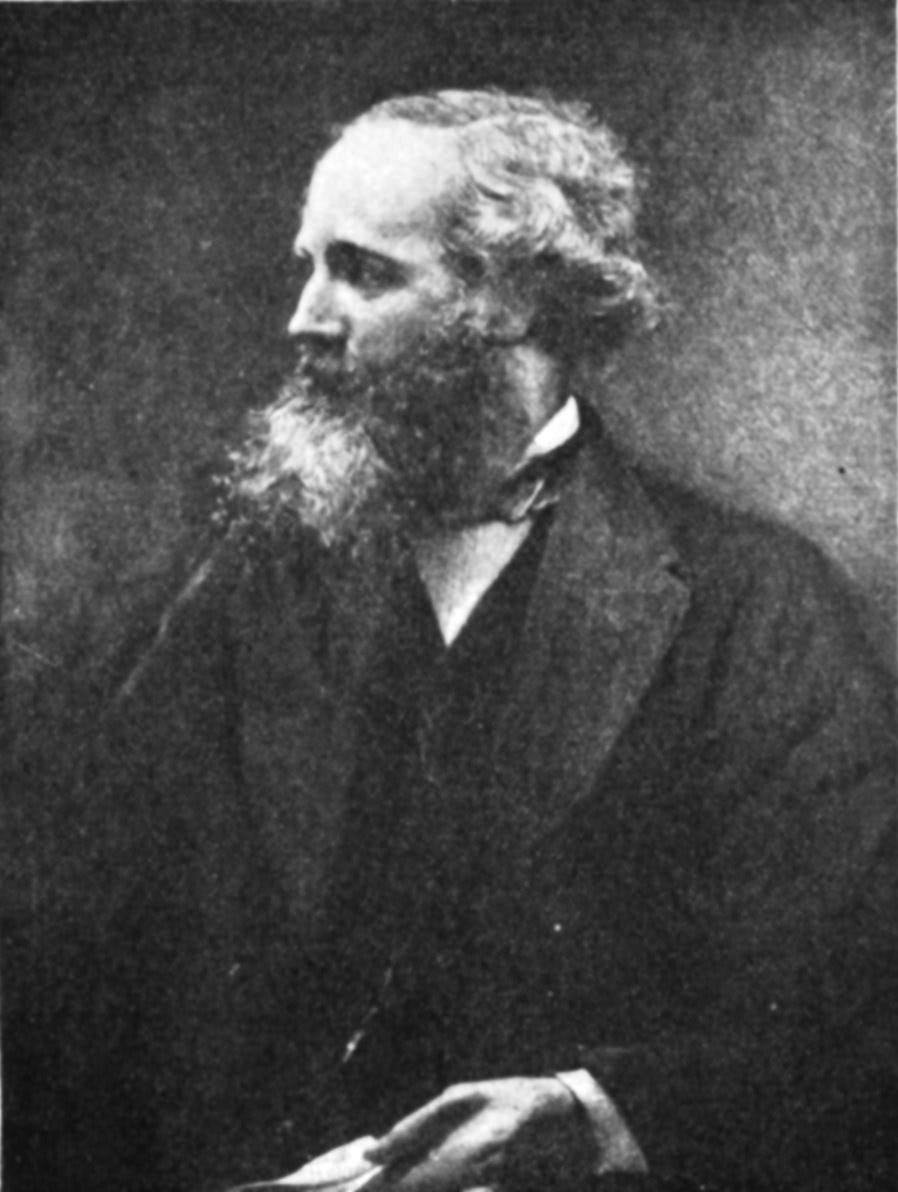
On the eleventh of December 1867, James Clerk Maxwell sat down to write to his friend Peter Guthrie Tait. He was thirty six. What he wanted, he told Tait, was to pick a hole in the second law of thermodynamics.
The hole he proposed had a caretaker.
Imagine two chambers of gas at exactly the same temperature, and a door between them. Now imagine something standing at that door, watching the molecules come. Molecules in a gas do not all move at one speed; they move at a spread of speeds, and temperature is only the average. So the being waits, and opens the door for a fast molecule heading left and a slow one heading right, and keeps it shut for everything else.
Wait long enough and one side is hot and the other is cold. Nothing has been pushed, lifted, burned, or spent. A difference has appeared out of a room that had none.
A very observant and neat fingered being
That phrase is Maxwell’s, and not the one that survived. Writing to Tait he summarized what his creature had achieved: “The hot system has got hotter and the cold colder and yet no work has been done, only the intelligence of a very observant and neat fingered being has been employed.”
Neat fingered. Observant. Intelligent. Those are the whole toolkit.
When he made the argument public in Theory of Heat in 1871, he was careful in a way that later readers were not. “But if we conceive a being whose faculties are so sharpened that he can follow every molecule in its course,” he wrote, “such a being, whose attributes are still as essentially finite as our own, would be able to do what is at present impossible to us.”
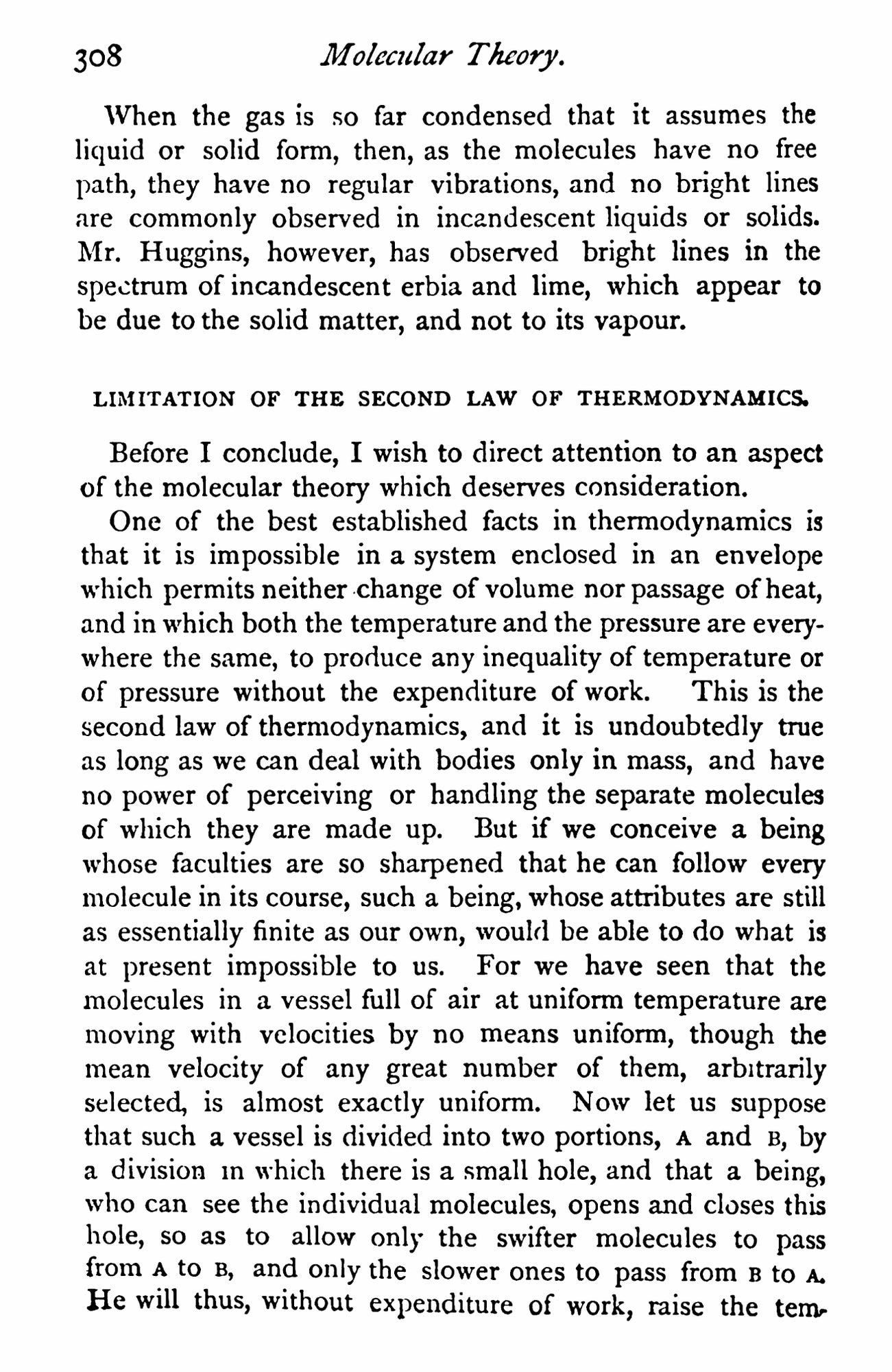
Read that middle clause again. As essentially finite as our own. Maxwell insists, in the same breath that introduces the thing, that it is not supernatural. It is not a god and not a devil. It is a creature exactly as limited as we are, only faster and more careful, able to see one molecule where we see millions at once.
The word demon was not his. William Thomson introduced it in 1874, in Nature, in a paper on the dissipation of energy, and it stuck so hard that Maxwell’s careful finite creature was buried under it. The Greek daimon was an intermediary spirit rather than a devil, closer to what Maxwell meant than the word’s later career suggests. He never used it himself.
The sentence everyone walked past
Here is what usually gets lost. Maxwell was not trying to prove the second law false. He was trying to show it was a different kind of law than anyone had assumed.
He was still saying so a decade later, in an encyclopaedia article on diffusion, in one of the strangest sentences a Victorian physicist ever committed to print: “The idea of dissipation of energy depends on the extent of our knowledge.”
The idea of dissipation of energy depends on the extent of our knowledge.
It is a claim that one of the central quantities in physics is not a property of the gas alone. Entropy, on this reading, belongs to the gas together with what can be known about it. The molecules do not change. The demon does not touch them, or heat them, or push them. It sees them individually rather than in bulk, and that alone is enough to move a quantity thermodynamics treats as real.
Change the knower, and you change the number.
That is a strange thing to find in nineteenth century physics. Stranger still is what happened next, which is nothing. For sixty years the demon was passed around, argued over, and left where it was.
One molecule, one bit, one number
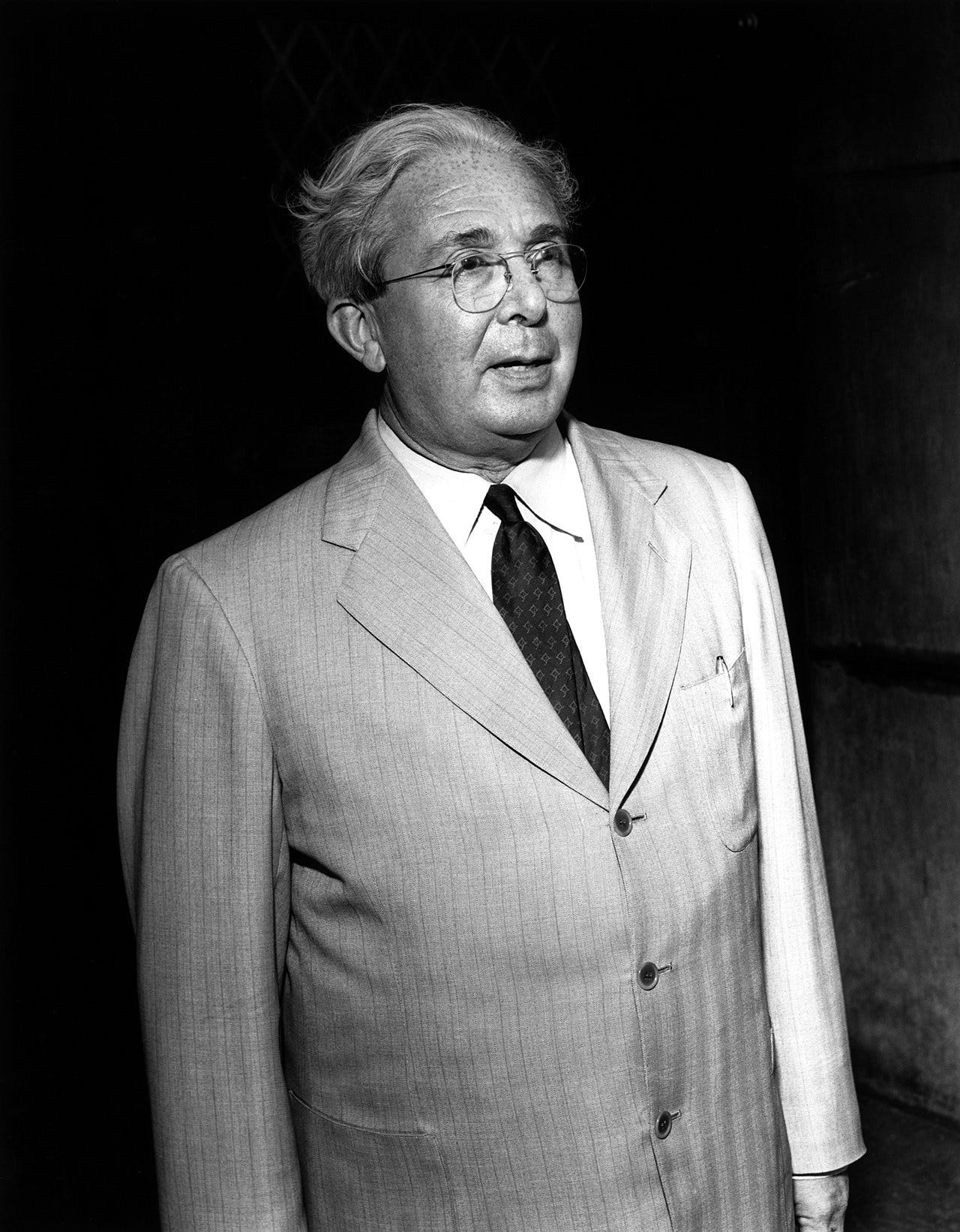
Then in 1929 a Hungarian physicist named Leo Szilard published a paper whose title shows how far the problem had traveled from the gas: “On the decrease of entropy in a thermodynamic system by the intervention of intelligent beings.”
Szilard did the thing that turns a puzzle into physics. He made it smaller. One box, one molecule, one partition. The molecule is on the left or on the right. That is the entire state of the world, and knowing it is one yes-or-no question answered, which is to say one bit.
And from that single bit, Szilard showed, you can extract work. A specific, calculable amount: at most kT ln 2, where T is the temperature and k is Boltzmann’s constant.
One molecule. One thing known about it. One quantity of usable energy at the end.
Szilard’s conclusion was that the second law survives, and survives because the demon’s measurement cannot be free. The knowing has to carry an entropic price at least as large as what it buys, or the books do not balance.
Whether entropy and information are therefore the same quantity wearing two names is a harder question, and still open. Some hold the informational reading is essential. Others, John Norton and Orly Shenker among them, argue it is a relabelling that adds nothing you did not already have. I am not going to settle that here, and I would be suspicious of anyone who claimed to.
What is not in dispute is smaller and stranger and enough: a thought about a gas turned out to have a price. Szilard’s answer, as it happens, was right about the conclusion and wrong about where the cost sits, and correcting it took another fifty years. That is not this essay.
What the hole let through
The demon’s only power is attention. No strength, no leverage, nothing to heat anything or push anything with. All it does is watch a great many things, one at a time, and act at the right moment. Everything it achieves comes from noticing.
There is a line that circulates in modern spiritual writing: where attention goes, energy flows. The phrasing is recent and usually sold as older than it is. But it compresses something with a much longer pedigree. Patanjali gives sustained attention a technical name, samyama, defined at the opening of the third chapter of the Yoga Sutras as concentration, meditation and absorption held together on a single object. What follows is a catalogue: hold samyama on this, and you obtain that. Attention there is not a state you rest in. It is an operation, and it yields.
Now set that beside what Szilard proved. A being that knows which half of a box its molecule is in can turn that knowing into kT ln 2 of work. Knowledge on one side, joules on the other, convertible at a fixed rate.
None of which means Patanjali anticipated thermodynamics. He did not, he was not trying to, and a resemblance is not evidence of anything. What I notice is narrower and harder to shake. Two systems that share no vocabulary, no method, and no century both refuse to let attention be free. One says it costs the attender and returns something. The other says it costs the demon and returns joules. Both put a price on noticing.
Attention is not free. Somebody pays.
Maxwell wanted to pick a hole in the second law. He found one, and it held. What came through it was not a broken law. It was the discovery that the law had a knower inside it the whole time, and that nobody had thought to look.