


It is three in the morning and your mind will not settle. The afternoon’s conversation plays again, with better lines this time, and behind it come the email you forgot to send and a number that still does not add up. Nothing arrives in order. It all comes up at once, like silt kicked up from the bottom of a glass, and hangs there in the dark.
We have a word for this now, and it is a physicist’s word. My head is pure entropy. The relationship slowly turned into entropy. We use it for anything that has come apart and will not go back together.
More than two thousand years ago, a Chinese text traditionally attributed to Laozi gave different advice for the same condition. Chapter fifteen of the Dao De Jing asks: 孰能濁以靜之徐清, who can take what is muddy and, by stillness, slowly make it clear?
What I got wrong about a deck of cards
I have used the word loosely here too. Three essays ago, explaining Boltzmann’s equation, I wrote that a system drifts toward the descriptions there are more of “for the same reason a shuffled deck comes out disordered.” The counting in that sentence was right. The word was wrong.
Shuffling a deck changes nothing a thermometer could register. What Boltzmann counted was the number of ways the energy and the molecules of a system can be arranged while it stays, to our coarse eyes, the same system, and tidiness never came into it. Disorder is a picture we lay over that count, and most of the time it fits well enough to be useful.
The glass of muddy water is where the picture stops fitting. Leave it alone and the grains sink and the water clears, which looks like entropy running backward, mess turning into order with nobody tidying. What happens is the reverse. Each grain that falls gives up its height to the water as a little warmth, spread among more molecules than anyone could count, and the total number of ways goes up. The glass is obeying the second law the whole time.
The clarity is in what you can see. The entropy is in what you cannot.
Two entropies in one head
The slide from entropy to disorder is so easy that serious science makes it too. In 2014 Robin Carhart-Harris and his colleagues proposed what they called the entropic brain, and their abstract opens by noting that entropy can “imply physical qualities, where high entropy is synonymous with high disorder.”
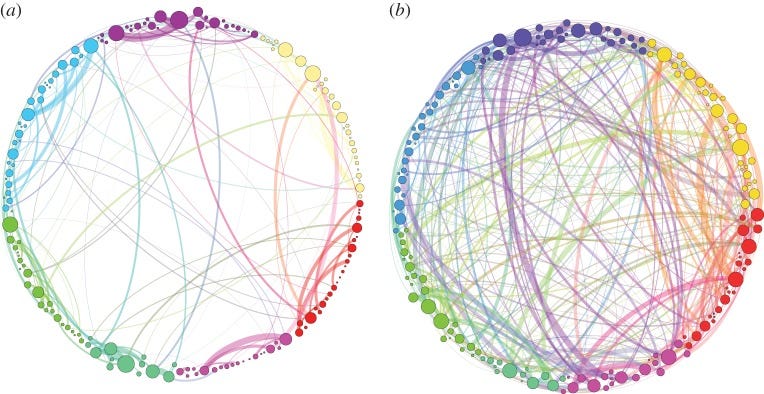
What they measure is something else, and more interesting: entropy in Shannon’s sense, how varied and unpredictable the brain’s spontaneous activity is, how large the repertoire of patterns it moves through. On their proposal, that repertoire widens under psychedelics, and ordinary waking consciousness is a state in which it is held in check, kept just short of the point where order gives way. It is a hypothesis, and it is argued over, but the measure is clear.
Gustavo Deco and his colleagues come at it from the thermodynamic side. A system at equilibrium looks the same whether you run its film forward or backward; a system far from equilibrium has an arrow of time, and physicists measure that arrow as the rate at which it produces entropy. That rate is hard to get from brain signals, so Deco’s group uses a simpler stand-in: how easily you could tell a recording of brain activity from the same recording played backward. In 2022, using electrodes on the surface of the brain in monkeys, they found that arrow sharper in wakefulness than in deep sleep or under most anesthetics, and sharpening again as the animals came back.
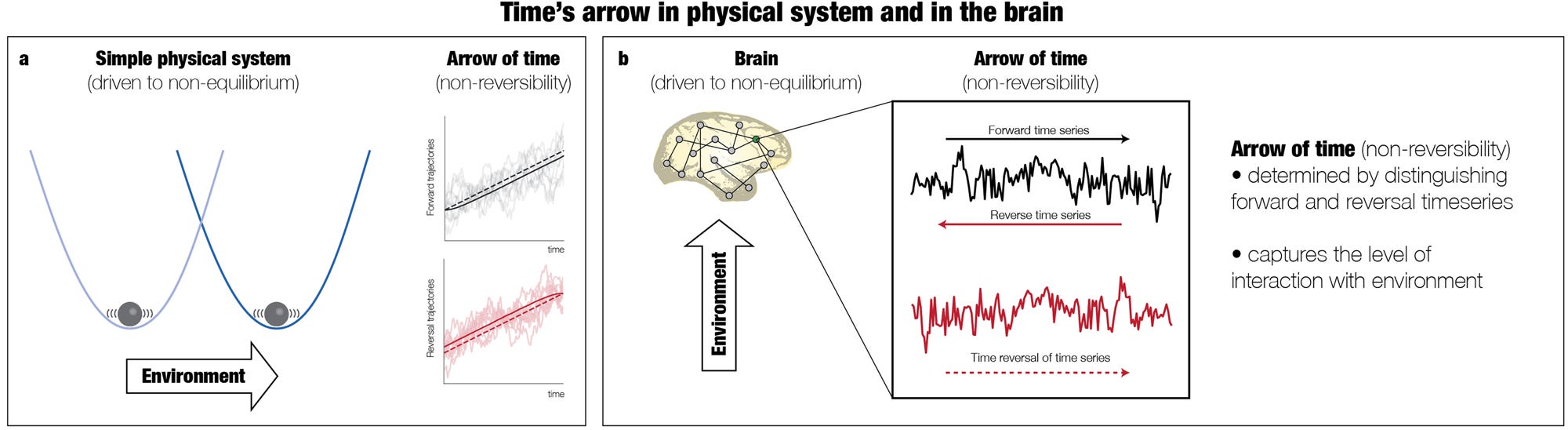
So one word reaches into the skull as two measures, answering different questions. One asks how many different states the brain visits, the other how far its flow is from coming to rest. By the first, set against the psychedelic state, waking is the constrained one. By the second, set against sleep and anesthesia, waking is the one furthest from still.
Three weeks ago I said that a shared form is not evidence of a shared thing until it predicts something. A shared name is weaker still, and here we can watch it split in two.
Still water is not a quiet mind
The settled glass is equilibrium. Film it, play the film backward, and nobody could tell you which way it ran. No one would put a glass of water on Deco's scale, but in principle it belongs at the zero point, below deep sleep and anesthesia, where there is no arrow at all. Whatever Laozi meant by clarity, it cannot be that.
A mind that becomes as still as the glass has not become clear. It has stopped.
Last week I proposed that information is not simply something that is, but something that is done. A thinking brain keeps doing it, holding itself away from equilibrium and paying for that all the time, even at three in the morning. I do not know what these measures show in a meditating brain, and I will not pretend to. But if Laozi’s stillness is anything real, it has to be a kind of movement.
The chapter seems to know this. Straight after the muddy water it asks the opposite question: 孰能安以久動之徐生, who can take what is at rest and, by long movement, slowly bring it to life?
Stillness makes clear. Movement makes alive.
The glass settles, and then nothing more happens; the count has gone as high as it can go. A living thing is exactly what does not do that. Which leaves the question the next essay is for: what is entropy counting, when what it counts is not grains in a glass, but lives?
The muddy water example finally made entropy make sense to me in a way that “disorder” never really has. The water looks like it's becoming more orderly while entropy is actually increasing. That's wonderfully counterintuitive.