




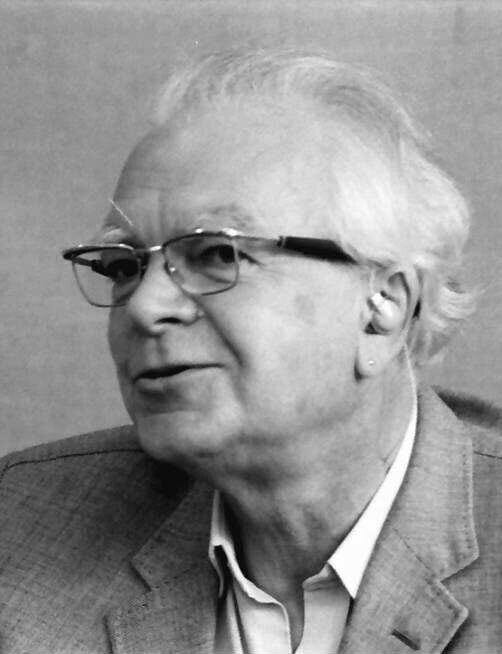
In 1963, a biochemist in his early forties resigned from the University of Edinburgh with acute gastric ulcers and moved to Cornwall. For the next two years he did no science at all. In the words of his Nobel biography, he acted as architect and master of works, restoring a Regency-fronted house in the wooded Glynn Valley near Bodmin and turning much of it into a laboratory. In 1965 he started work there again, with his former colleague Jennifer Moyle and one technician, Roy Mitchell, no relation.
His name was Peter Mitchell. The idea he carried into that house had been in print for four years, and almost nobody believed it.
Two weeks ago, in the essay about the olive, Lloyd Demetrius listed the currencies a living thing pays in, since heat can do almost no work inside a cell. Chemical bonds. Electrons handed along. Light caught by a pigment. And one more, almost in passing: concentrations held unequal across a membrane. This essay is about that last one, because it turns out to be the one the others pass through.
A wall a tenth of a volt thick
By the 1950s biochemists knew that a cell burns its food in small steps and stores the proceeds in ATP, the molecule it spends for almost everything. What they did not know was how the burning was coupled to the storing. Most assumed there had to be a link in between, some energy-rich compound handed from one machine to the other. Laboratories spent years hunting for it and found nothing, and none of their schemes explained why the process needed an intact membrane at all.
In 1961 Mitchell proposed, in a short paper in Nature, that there was no compound to find. The machinery of respiration sits in the membrane facing one way, and as electrons pass through it, protons are pushed to one side. What builds up is a difference: more charge and more acid on one side of a thin wall than on the other. ATP is made as the protons flow back through a second machine, the way a mill is turned by water returning downhill. The membrane has to be intact for the same reason a dam does.
The presentation speech for his Nobel Prize described the reception politely. The hypothesis had been met “with reservation,” the speaker said, being “unorthodox, fairly provocative, and based on little experimental evidence.” The press release was blunter: skepticism, then fifteen years of experiments in many laboratories, until the basic postulates were accepted. He received the 1978 Prize in Chemistry alone. The address printed under his name was Glynn Research Laboratories, Bodmin.
Measured in isolated mitochondria, the difference across the inner membrane runs from about 150 to about 180 millivolts, about a tenth of what a single AA battery delivers. But the wall it sits across is about five nanometers thick, five billionths of a meter. Divide one by the other and the field inside the membrane comes to roughly thirty million volts per meter. Dry air breaks down into a spark at around three million. A review of the subject notes, with some understatement, that a field that high “is difficult (and energetically expensive) to maintain.”
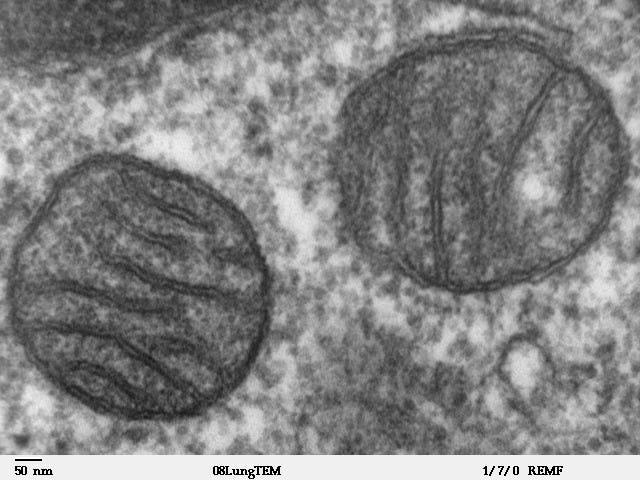
What biochemistry had been looking for was a thing. What Mitchell found was a disagreement between two sides.
Changing, it rests
A neuron has the same habit, at the outer membrane rather than inside the mitochondrion. Its inside is held negative with respect to the outside, a few tens of millivolts, by pumps that move sodium out and potassium in, spending ATP every time they turn. Physiologists call this the resting potential. Nothing about it rests. Stop the pumps and the difference drains away, the way the glass of muddy water in the sixth essay settled once it was left alone.
The cell does not keep its energy in a thing. It keeps it in a disagreement.
How much it costs has been estimated. In 2001 David Attwell and Simon Laughlin worked out an energy budget for signaling in the gray matter of the rodent brain. On their figures, keeping the resting potential takes about an eighth of the energy spent on signaling, and the spikes themselves close to half. It is a model rather than a measurement, and later work has revised parts of it, but its shape has held: much of what a brain spends, it spends restoring gradients.
A spike is the gradient let go. For a thousandth of a second, channels open along a patch of membrane, ions rush down the difference that the pumps built, and the disturbance travels to the next patch, which does the same. Then the pumps put it back.
Follow the chain end to end. A proton difference across one membrane makes ATP. ATP rebuilds a sodium and potassium difference across another. The signal spends that difference, and ATP is spent rebuilding it. These are not the same ions, and not the same wall. They are the same move, made twice.
Around the middle of the third century, Plotinus opened a treatise on how the soul comes down into the body by turning to Heraclitus, who, he wrote, urges us to search for exactly this and then leaves us to guess, “neglecting to make his account clear to us.” Among the phrases he quotes from him is one two words long: μεταβάλλον ἀναπαύεται. Changing, it rests.
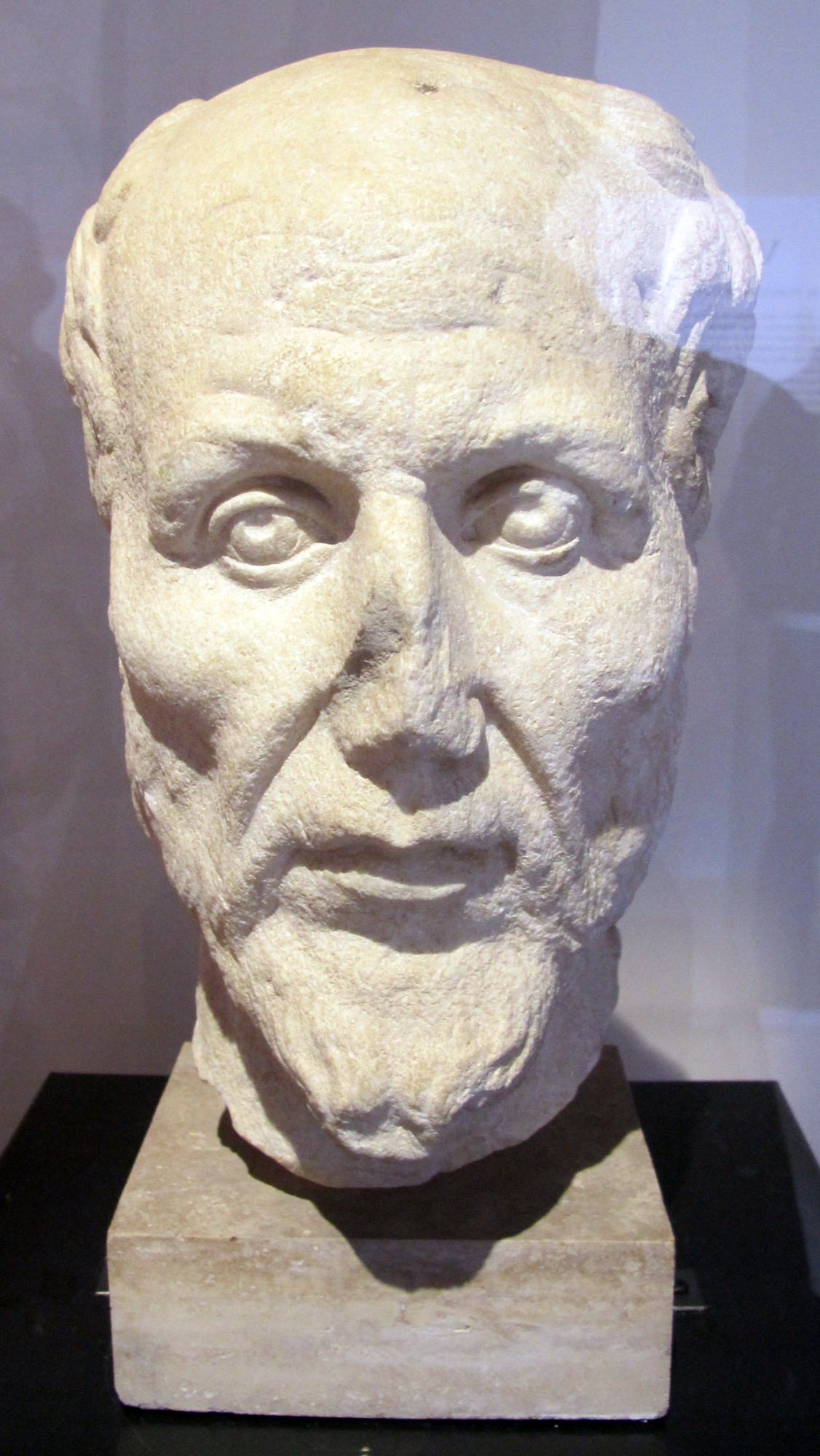
Heraclitus was speaking of the cosmos, or the soul; scholars still argue which. He was not speaking of membranes, and a fragment is not evidence for a voltage. Set it beside the neuron anyway. The only rest available to a living membrane is the kind that is made, moment by moment, out of change.
Provided with energy
In the fifth essay I quoted Gregory Bateson’s definition of information as a difference which makes a difference, and pointed to the clause that usually gets cut: the difference can make one, he said, because the pathways it travels along “are themselves provided with energy.” This is why I needed it.
I have been proposing that information is form in action: not a shape stored in a medium, but a shape at work in something it changes. If that is right, it has to draw its work from somewhere. Mitchell’s answer, and the neuron’s, is that the energy is itself a held difference, kept open across a boundary and spent by letting it go. On this reading the signal and the fuel are not two kinds of thing. They are one kind of thing, a difference across a wall, at two moments. That is my reading, not Mitchell’s, and like the last one it has to earn its keep by telling us where to look.
In 1978 his Nobel biography noted that the institute in the valley had never been able to afford more than three researchers, and that it might soon have to close. It kept going. While you read this, the mitochondria in almost every cell of your body are holding more than a tenth of a volt across a wall five billionths of a meter thick, and putting it back as fast as you spend it.
Further reading:
Mitchell, P. (1961). Coupling of phosphorylation to electron and hydrogen transfer by a chemi-osmotic type of mechanism. Nature, 191, 144-148. https://doi.org/10.1038/191144a0
Peter Mitchell, Biographical; Award ceremony speech; Press release (1978). NobelPrize.org. https://www.nobelprize.org/prizes/chemistry/1978/mitchell/biographical/
Zorova, L. D., et al. (2018). Mitochondrial membrane potential. Analytical Biochemistry, 552, 50-59. https://doi.org/10.1016/j.ab.2017.07.009
Attwell, D., & Laughlin, S. B. (2001). An energy budget for signaling in the grey matter of the brain. Journal of Cerebral Blood Flow & Metabolism, 21(10), 1133-1145. https://doi.org/10.1097/00004647-200110000-00001
Plotinus, Enneads IV.8.1, quoting Heraclitus (DK 22 B84a). Translation the author’s. On the fragment: Kurzová, H. (2012). Heraklit in Plotinus IV 8. AUC Philologica, 3, Graecolatina Pragensia XXIV.
Bateson, G. (1970). Form, substance, and difference. Reprinted in Steps to an Ecology of Mind (1972).

I am a pensioner who suffers from pulsating tinnitus (not so much suffering as awareness). Each night I lay my head down on a pillow and listen to a pulse behind my ear. The electrical charge, release and re-charge of my heart and respiration system. The only rest is the short gap between changes, where for a fraction of a second, there is silence.
Everything is nicely balanced and reliable. No chaos, yet. Sounds a bit like the mill metaphor wherein the mill is turned by water returning downhill. My heart being something like the dam and the grinding mill stone. A human system.
Now to the pensioner side of my existence. Here, again, is a human system. For forty years I toiled to fill my pension reservoir with potential financial energy. All the little positive charges I provided over the years accumulated. Then came retirement, my creditors and a relentless drain on my reservoir (bank account), all the negative charges. I can still fill the reservoir, but at a reduced rate, as the negative draw sometimes exceeds the positive refills. We all know where this ultimately leads. Pump failure, disassembly and chaos.
I guess my point here (if I have one) is: the tiny, intricate machinery within the living, human body is replicated by human beings to fit the macro world their bodies live in. God creates, humans replicate.
And as to Peter Mitchell, it sounds as though civilization was eating him up from the inside. His cure was to use his hands to build something beautiful, calming and peaceful, like the flow of water through a water wheel.
It's mind boggling how guys like Mitchell can stay focussed for so many years on unravelling the mystery behind such a tiny detail. Many might respond, "So what?", but as George's comment illustrates, what Mitchell discovered highlights a universal principle that operates at every level, from the microscopic to the galactic, and includes the in-between level of practical daily life.
Somewhere in Mitchell's research and findings lies a key to successful living. It's difficult to articulate, but it can be felt.
My take on it is that everything is simply Form and Flow. Each form is a temporary disruption, an imbalance in the stuff of Reality, which we mostly experience as Matter. Flow is the natural tendency to restore balance, which we mostly experience as Energy.
So, to produce (form) something we want to have in our life, we need to create a disruption into which the form of that thing will naturally flow, and maintain that disruption.
Imagination and desire are the beginning of that disruption. But it stops there unless we follow through with sustained action, which draws in the Flow to shape the desired Form.
In the case of Mitchell, he bravely sustained his "disruption" for many years, despite seemingly overwhelming opposition, and finally established a truth. I take my hat off to the amazing guys who can do that.
There's only space for a few crumbs in this comment, but I hope it's enough to give a taste of the whole loaf.